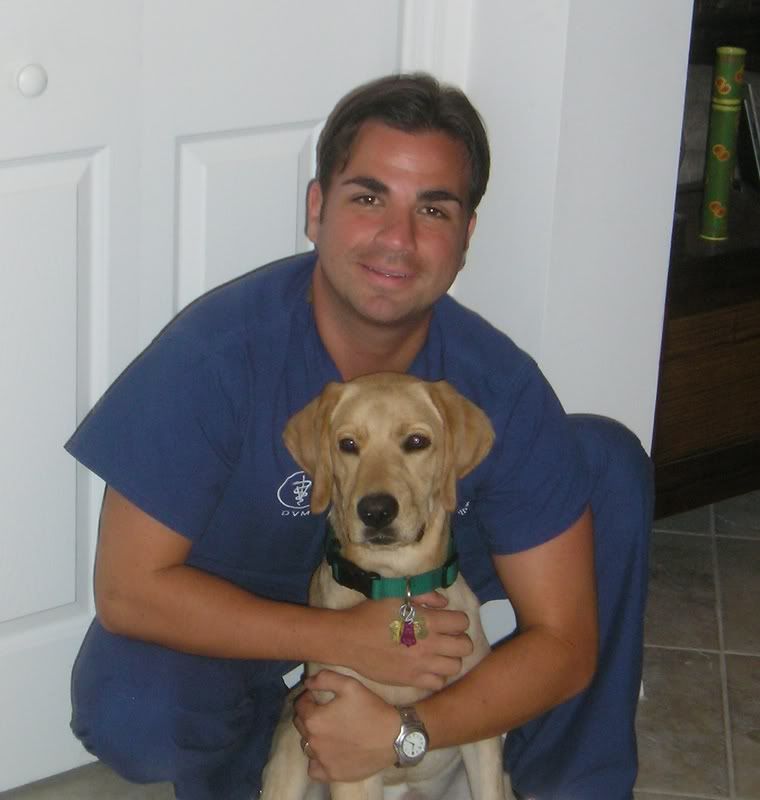
This is one of the those stories that seems too unbelievable to be true. My hospital's associate veterinarian admitted a small chihuahua for having a few broken teeth. The story of the events that led to the broken teeth just blew us all away!
The owner of this chihuahua lives in a multilevel retirement condominium that requires constant elevator use to get downstairs for any reason, including to walk her little dog. The chihuahua's owner uses one of those flex leashes, where the leash is coiled up in a plastic mechanism within a handle, where the owner controls the length of the leash with a button/lock mechanism. These leashes can be as long as 10-15 feet, unravelling without resistance as the dog moves foward until the owner either stops the extension by pressing the lock button, or the coil runs out of slack. For the record, I detest these kinds of leashes.
The chihuahua and her owner had entered the elevator to go up to their home and the elevator made a stop at one of the lower floors, where there was a man waiting to enter. Being the territorial ankle biter that many chihuahuas are, the chihuahua aggressively ran at the man that was still on the other side of the open elevator door. The owner did not press the lock button on the flex leash in time, so the dog was able to run out of the elevator and into the hallway. Unable to reel the dog back in, the elevator doors closed with the owner inside the elevator holding one end of the leash, and the dog on the other side of the closed elevator door still attached to the other end of the leash. From the owner's perspective, as the elevator started to go up, the leash slid to the bottom of the closed elevator door, became very taught with tension, then quickly snapped.
From the other side of the elevator door, the gentleman who had remained in the hallway for fear of the little dog that was attacking him, did not enter the elevator. After the elevator door closed and continued to go up, from his perspective, the dog still attached to its leash, began to slide up the closed elevator doors. Acting quickly and heroically despite the dog's bad intentions for him, the man ran to the dog's rescue and unsnapped the dog's collar, just nanoseconds before the end of the leash with collar, got sucked up into the elevator shaft through the tiny slit of the closed elevator doors. Had the man not acted so quickly, the dog truly would have likely been decapitated.
Thinking that her dog had indeed been decapitated, upon the owner's return, she was elated to see that the dog was not only alive, but alert and responsive, only moderately bleeding from the mouth and terrified. Ultimately, aside from a few damaged teeth that had to be removed, the chihuahua escaped the incident unharmed.
That is one lucky dog to have been saved by a man for whom the dog showed blatant aggression. I hope she learned a lesson!
Roger L. Welton, DVM
founder, WebDVM
Monday, December 10, 2007

Saturday, December 1, 2007
Bubbles, My Inspiration.
Upon assuming ownership of my current practice 3 years ago, I would have loved to immediately hire Dr. Mengering, (the doctor I purchased from), but with the financial uncertainty of a change of ownership, I feared that it would not end up financially feasible. As such, I ran the practice without the services of Dr. Mengering my first year (thankfully, this has changed and she is now a part time associate), which did not sit well with some of her regular clients, none less than a senior aged owner of a chubby little chihuahua named Bubbles.
I first met Bubbles one week after after I had taken over in December of 2004. Bubbles owner was rather blunt about her displeasure that she could no longer have her beloved Bubbles seen by her trusted veterinarian of many years, instead having to trust her dog's life with the likes of me, a 30 year old vet who was only 3 years out of vet school. I did not take it personally not only because I could understand her point of view, but also because of Bubbles medical history.
Upon thumbing through her record, I saw that Bubbles has battled and survived repeated bouts of life threatening pancreatitis, that were later finally determined to have been precipitated by and endocrine disease known as Cushings Disease. Once the treatment for Cushings was in place, her pancreatitis had stopped returning and her health was in a delicate, but effectively managed state. Having had such an extensive medical history, I could completely see why Bubbles owner had some apprehension about starting with a new vet, a young one at that.
Within a fairly short time, however, Bubbles owner began to trust me, and we gradually developed a very nice professional relationship. In fact, she was quickly becoming one of my most beloved clients, and I just adored little Bubbles. Even after Dr. Mengering's return, she comfortable to see whichever one of us was available, not hold out to be seen only on Dr. Mengering's days, as some of her regulars chose (and still choose) to do.
In year 2 of managing Bubbles health, she suddenly became very ill one day. Blood work revealed that the medication that was managing her Cushings Disease was causing her kidneys to shut down, creating the need to both hospitalize her and stop the Cushings medication. Aggressive treatment was successful and Bubbles was discharged in a few days, but I could no longer treat her Cushings disease for risk of harming her kidneys.
Over time her Cushings Disease began to take its toll on her body, and she had yet another bout of pancreatitis. We were once again able to stabilize Bubbles, and thankfully a new cutting edge Cushings Disease treatment with virtually no adverse side effects had come available, so we now once again manage her Cushings Disease.
In the next 2 years, while Bubbles' Cushings Disease has remained under control, I have had to treat Bubbles for upper GI ulcer, herniated disc in her neck, anal sacs abscesses, tooth root abscess, chronic obstructive pulmonary disease (COPD), and in every instance, she has recovered. During this heights of her illnesses, she remained sweet, affectionate, and never once resented any blood draws, catheters, or any other procedures we had to implement in her diagnostics and treatments. Her daily medication regimen was a long as a grocery list.
In my most recent visit with Bubbles, her COPD has led to secondary enlargement of her heart and the subsequent development of congestive heart disease, and once again, she had bounce back from the abyss and is doing well on yet more treatment. This little dog's courage and will to live, as well as her mother's dedication, has touched my heart in an unforgettable way. Now 12 years old and juggling so many health issues, I know that the day will come that we will lose the battle. While that will be one of the most difficult days of my career, I will always be grateful for having had the honor of taking care of Bubbles and her wonderful Mommy.
Roger L. Welton, DVM
Founder, WebDVM
I first met Bubbles one week after after I had taken over in December of 2004. Bubbles owner was rather blunt about her displeasure that she could no longer have her beloved Bubbles seen by her trusted veterinarian of many years, instead having to trust her dog's life with the likes of me, a 30 year old vet who was only 3 years out of vet school. I did not take it personally not only because I could understand her point of view, but also because of Bubbles medical history.
Upon thumbing through her record, I saw that Bubbles has battled and survived repeated bouts of life threatening pancreatitis, that were later finally determined to have been precipitated by and endocrine disease known as Cushings Disease. Once the treatment for Cushings was in place, her pancreatitis had stopped returning and her health was in a delicate, but effectively managed state. Having had such an extensive medical history, I could completely see why Bubbles owner had some apprehension about starting with a new vet, a young one at that.
Within a fairly short time, however, Bubbles owner began to trust me, and we gradually developed a very nice professional relationship. In fact, she was quickly becoming one of my most beloved clients, and I just adored little Bubbles. Even after Dr. Mengering's return, she comfortable to see whichever one of us was available, not hold out to be seen only on Dr. Mengering's days, as some of her regulars chose (and still choose) to do.
In year 2 of managing Bubbles health, she suddenly became very ill one day. Blood work revealed that the medication that was managing her Cushings Disease was causing her kidneys to shut down, creating the need to both hospitalize her and stop the Cushings medication. Aggressive treatment was successful and Bubbles was discharged in a few days, but I could no longer treat her Cushings disease for risk of harming her kidneys.
Over time her Cushings Disease began to take its toll on her body, and she had yet another bout of pancreatitis. We were once again able to stabilize Bubbles, and thankfully a new cutting edge Cushings Disease treatment with virtually no adverse side effects had come available, so we now once again manage her Cushings Disease.
In the next 2 years, while Bubbles' Cushings Disease has remained under control, I have had to treat Bubbles for upper GI ulcer, herniated disc in her neck, anal sacs abscesses, tooth root abscess, chronic obstructive pulmonary disease (COPD), and in every instance, she has recovered. During this heights of her illnesses, she remained sweet, affectionate, and never once resented any blood draws, catheters, or any other procedures we had to implement in her diagnostics and treatments. Her daily medication regimen was a long as a grocery list.
In my most recent visit with Bubbles, her COPD has led to secondary enlargement of her heart and the subsequent development of congestive heart disease, and once again, she had bounce back from the abyss and is doing well on yet more treatment. This little dog's courage and will to live, as well as her mother's dedication, has touched my heart in an unforgettable way. Now 12 years old and juggling so many health issues, I know that the day will come that we will lose the battle. While that will be one of the most difficult days of my career, I will always be grateful for having had the honor of taking care of Bubbles and her wonderful Mommy.
Roger L. Welton, DVM
Founder, WebDVM
Tuesday, November 20, 2007
Dog With Narcolepsy!
I have never seen anything like this in my career, nor have I even learned that this disease can affect dogs. UNTIL NOW!! Click the link below:
DOGGY NARCOLEPSY
DOGGY NARCOLEPSY
Saturday, November 17, 2007
Another Reason To Be Wary Of Breeders
Two days ago, a dear client of mine came in a with a 4 month old pug puppy they had just purchased. The purpose of the visit was to administer the final round of vaccines, but also to check a "protrusion" coming out of the vagina that was giving the puppy discomfort every time she sat. Under the breeder's care, the puppy had only had one puppy vaccine at the age of 11 weeks (puppy vaccines should be started at 6 weeks, then boostered again at 9 and 12 weeks), and came with no state health certificate for sale signed by a veterinarian, a legal requirement to sell any animal in Florida. Both of these facts concerned me from the beginning of this visit.
Upon examination, I was fairly certain that the "protrusion" from the vaginal cavity was actually a small penis, meaning that the puppy was born with mixed male and female reproductive organs, a condition known as hermaphroditism. I explained to the owner that the puppy would need to have an imaging contrast study to ascertain the exact location and path of the urethra and lower urinary tract, before it can be decided whether I could perform the surgical correction, or whether this needed to be in the hands of a specialist. I also informed the owners that altering the patient could be tricky, as the puppy could have ovaries, testes, or both, and only abdominal exploratory surgery would reveal this.
The owners were already attached to this puppy, but they were concerned about making the financial commitment necessary to repair the puppy's deformity; a puppy that had been in their lives for less than 24 hours. I attempted to quell their concerns by telling them about the Florida State puppy lemon law, which states that if within 14 days of purchase, a veterinarian deems that a puppy if sick or has one or congenital deformities, the owners are entitled to return the puppy for a full refund, or be compensated for medical fees up to and including the price of the animal. Many breeders will try to worm their way out of this responsibility, but I thought that this breeder would likely capitulate knowing that he had already broken the law once by not having a health certificate for the puppy he sold.
The next day, the owners of the puppy called me very upset that the breeder had informed them that he was not going to provide them with a refund, that they were misinformed about both the lemon law and health certificate requirement. He told them that the puppy was theirs for better or for worse. What's more, when they called the vet where the puppy had received her one and only vaccine, they informed the owners that they had denied dispensing a health certificate on the grounds of her deformity! This fact confirmed that this breeder knowingly and purposefully sold this puppy with a deformity.
I decided that I would call the breeder myself on behalf of the owners. Often, once a breeder knows that an owner has the full backing and support of a licensed veterinarian to pursue legal satisfaction, they change their tune. I reached the breeder's voice mail and left him a message stating that he had already broken the law once by selling a puppy without a state health certificate, and he is breaking yet a second time by not observing the lemon law. As such, I informed him that I will offer the owners my full support and testimony for any legal action they take against him in this matter, if he does not concede and do the right thing.
The breeder called me back in a short period of time and started yelling a string of profanities, meanwhile threatening that he was going to use my message to have my license taken away. To this I laughed and told him how funny the state board will find it when an unethical and unlawful business man approaches them demanding that a they revoke the license of a veterinarian with a flawless record in 7 years of practice - all on the grounds of my attempt to help my clients uphold the law and preserve their rights. To this he became hostile and said,"Yeah? How about I just come down to your place and smack you like a little female dog [he used a different word for this]?" At that, I told him the conversation was over and hung up.
I called the owners back shortly thereafter and informed them that they were unfortunately dealing with, not only an unethical and unlawful breeder, but a sociopath as well. Interestingly enough, the owners told me that the breeder had already called them back with a completely different demeanor, offering his apologies and a full refund that they can put toward having the puppy's deformity fixed. I guess despite all of his hostility, I must have made an impression.
These owners and their puppy have potentially a tough road ahead of them in getting this puppy right, but at least they have the financial relief that was rightfully theirs, to offset the financial burden that the puppy's treatment could end up costing them. I offer this story so that the public is aware of the caliber of people they could end up dealing with, even when partaking in an activity as innocent as buying a puppy. Always beware of people like the breeder in this story.
Upon examination, I was fairly certain that the "protrusion" from the vaginal cavity was actually a small penis, meaning that the puppy was born with mixed male and female reproductive organs, a condition known as hermaphroditism. I explained to the owner that the puppy would need to have an imaging contrast study to ascertain the exact location and path of the urethra and lower urinary tract, before it can be decided whether I could perform the surgical correction, or whether this needed to be in the hands of a specialist. I also informed the owners that altering the patient could be tricky, as the puppy could have ovaries, testes, or both, and only abdominal exploratory surgery would reveal this.
The owners were already attached to this puppy, but they were concerned about making the financial commitment necessary to repair the puppy's deformity; a puppy that had been in their lives for less than 24 hours. I attempted to quell their concerns by telling them about the Florida State puppy lemon law, which states that if within 14 days of purchase, a veterinarian deems that a puppy if sick or has one or congenital deformities, the owners are entitled to return the puppy for a full refund, or be compensated for medical fees up to and including the price of the animal. Many breeders will try to worm their way out of this responsibility, but I thought that this breeder would likely capitulate knowing that he had already broken the law once by not having a health certificate for the puppy he sold.
The next day, the owners of the puppy called me very upset that the breeder had informed them that he was not going to provide them with a refund, that they were misinformed about both the lemon law and health certificate requirement. He told them that the puppy was theirs for better or for worse. What's more, when they called the vet where the puppy had received her one and only vaccine, they informed the owners that they had denied dispensing a health certificate on the grounds of her deformity! This fact confirmed that this breeder knowingly and purposefully sold this puppy with a deformity.
I decided that I would call the breeder myself on behalf of the owners. Often, once a breeder knows that an owner has the full backing and support of a licensed veterinarian to pursue legal satisfaction, they change their tune. I reached the breeder's voice mail and left him a message stating that he had already broken the law once by selling a puppy without a state health certificate, and he is breaking yet a second time by not observing the lemon law. As such, I informed him that I will offer the owners my full support and testimony for any legal action they take against him in this matter, if he does not concede and do the right thing.
The breeder called me back in a short period of time and started yelling a string of profanities, meanwhile threatening that he was going to use my message to have my license taken away. To this I laughed and told him how funny the state board will find it when an unethical and unlawful business man approaches them demanding that a they revoke the license of a veterinarian with a flawless record in 7 years of practice - all on the grounds of my attempt to help my clients uphold the law and preserve their rights. To this he became hostile and said,"Yeah? How about I just come down to your place and smack you like a little female dog [he used a different word for this]?" At that, I told him the conversation was over and hung up.
I called the owners back shortly thereafter and informed them that they were unfortunately dealing with, not only an unethical and unlawful breeder, but a sociopath as well. Interestingly enough, the owners told me that the breeder had already called them back with a completely different demeanor, offering his apologies and a full refund that they can put toward having the puppy's deformity fixed. I guess despite all of his hostility, I must have made an impression.
These owners and their puppy have potentially a tough road ahead of them in getting this puppy right, but at least they have the financial relief that was rightfully theirs, to offset the financial burden that the puppy's treatment could end up costing them. I offer this story so that the public is aware of the caliber of people they could end up dealing with, even when partaking in an activity as innocent as buying a puppy. Always beware of people like the breeder in this story.
Tuesday, November 13, 2007
Who's Smarter, Dogs or Cats??
On 11/9/07, I introduced a Web Poll on our parent website, WebDVM 's home page, polling visitors about which species they feel is smarter, dogs or cats, a debate that has been going on for as long as these two species have been domesticated.
The dogs are smarter camp argue that dogs must be smarter because they answer to their names, come when they are called, and learn obedience and tricks so much more readily than cats. In addition, many fetch, hunt with their owners, and catch Frisbees.
The cats are smarter camp argue that cats are smarter because they generally do not follow, come when they are good and ready to and not on their owner's whim, since they are independently minded and more capable of making their own decisions; not having the need to "follow the leader." In addition, they are incredibly efficient self groomers, and use their front paws almost like hands at times.
At the time of the writing of this blog, there were 60 voters. 70% voted in favor of dogs being the smarter species, with 30% favoring cats as the more intelligent species. So who is right?
The answer to which species is smarter is unequivocally dogs. Dogs are descended from pack animals (wolves) that exhibit complex social behavior. Their existence is not one of equality, but one of hierarchy, starting with the alpha leader, and going all the way down to the lowly omega. This pecking order is essential to survival, enabling packs to formulate sophisticated hunting strategies, and feeding and mating order. Human society in a more highly evolved sense similarly oriented, with social order maintained by hierarchy in government, military, business, clubs and sports.
Dogs readily obey and do their master's bidding because in most cases, dogs view the owner as the alpha leader, being the one that provides food, obedience, and usually are of a physically larger stature. It is inherent in their pack nature to follow and obey their "superiors." Coming when they are called and responding to training are not signs of an animal that lacks the ability to think for itself, but reflect an intelligent intention to respond and react acutely to the signs and signals of its leader.
Cats, on the other hand are by their nature solitary animals, that do not depend on one another for survival, a sign of lower intelligence when compared to pack animals. They do not have the mental capacity to coordinate hunting strategy with others of their kind, nor are they able to create complex social interaction. Feline hunting is performed alone, with the cat operating more on instinct than premeditated planning.
Cats are very stress driven animals, constantly responding in a "fight or flight" manner to even non-threatening environmental stimulus. That is why they are often regarded as cautious and and sneaky. Stress driven existence is not only observable but is also seen quantitatively. On routine blood work, cats commonly have increased blood sugar and increased white blood cell counts though they are not sick. These are considered normal phenomena brought on by the stress of the visit, known respectively as stress induced hyperglycemia, and stress induced neutrophilia. This fight or flight first mentality is another sign of lower intelligence.
So there you have it, the debate answered from an objective, evolutionary, and scientifically based point of view. However, although they may not be generally as intelligent and subsequently social as dogs, cats often transcend their intrinsic nature. Many cats live harmoniously in multiple cat households, are very affectionate to owners and to one another, learn their names, and even come when they are called. Some, can even be taught to do tricks. It does not take pack evolved intelligence to make a loving, fun, and interesting pet!
Roger L. Welton, DVM
Founder, WebDVM
The dogs are smarter camp argue that dogs must be smarter because they answer to their names, come when they are called, and learn obedience and tricks so much more readily than cats. In addition, many fetch, hunt with their owners, and catch Frisbees.
The cats are smarter camp argue that cats are smarter because they generally do not follow, come when they are good and ready to and not on their owner's whim, since they are independently minded and more capable of making their own decisions; not having the need to "follow the leader." In addition, they are incredibly efficient self groomers, and use their front paws almost like hands at times.
At the time of the writing of this blog, there were 60 voters. 70% voted in favor of dogs being the smarter species, with 30% favoring cats as the more intelligent species. So who is right?
The answer to which species is smarter is unequivocally dogs. Dogs are descended from pack animals (wolves) that exhibit complex social behavior. Their existence is not one of equality, but one of hierarchy, starting with the alpha leader, and going all the way down to the lowly omega. This pecking order is essential to survival, enabling packs to formulate sophisticated hunting strategies, and feeding and mating order. Human society in a more highly evolved sense similarly oriented, with social order maintained by hierarchy in government, military, business, clubs and sports.
Dogs readily obey and do their master's bidding because in most cases, dogs view the owner as the alpha leader, being the one that provides food, obedience, and usually are of a physically larger stature. It is inherent in their pack nature to follow and obey their "superiors." Coming when they are called and responding to training are not signs of an animal that lacks the ability to think for itself, but reflect an intelligent intention to respond and react acutely to the signs and signals of its leader.
Cats, on the other hand are by their nature solitary animals, that do not depend on one another for survival, a sign of lower intelligence when compared to pack animals. They do not have the mental capacity to coordinate hunting strategy with others of their kind, nor are they able to create complex social interaction. Feline hunting is performed alone, with the cat operating more on instinct than premeditated planning.
Cats are very stress driven animals, constantly responding in a "fight or flight" manner to even non-threatening environmental stimulus. That is why they are often regarded as cautious and and sneaky. Stress driven existence is not only observable but is also seen quantitatively. On routine blood work, cats commonly have increased blood sugar and increased white blood cell counts though they are not sick. These are considered normal phenomena brought on by the stress of the visit, known respectively as stress induced hyperglycemia, and stress induced neutrophilia. This fight or flight first mentality is another sign of lower intelligence.
So there you have it, the debate answered from an objective, evolutionary, and scientifically based point of view. However, although they may not be generally as intelligent and subsequently social as dogs, cats often transcend their intrinsic nature. Many cats live harmoniously in multiple cat households, are very affectionate to owners and to one another, learn their names, and even come when they are called. Some, can even be taught to do tricks. It does not take pack evolved intelligence to make a loving, fun, and interesting pet!
Roger L. Welton, DVM
Founder, WebDVM
Friday, November 9, 2007
Good People: they do exist!
As in most other professions, in veterinary medicine, we are often exposed to some of the worst examples of the human race. It is not uncommon to hear statements like, "if this [treatment of the pet] is going to cost me more than 50 bucks, I'll just take her home and shoot her." Meanwhile, people of this ilk may drive a huge $60,000 diesel pick up truck, and/or wreak of alcohol. Obviously there is money available for the truck and the booze, but none to get treatment for the loyal companion who never asked to be owned by such scum.
Then we get home to see political scandals, violent religious fanatics, con artists, and gang violence on the news to further contribute to our overall disillusionment with humanity. Sometimes it is enough to make one feel as if it is pointless to try to infuse good into society by making the world better and safer for animals, by not only treating their illnesses and preventing disease, but also by changing the hearts of those who are ignorant to the fact that animals feel pain, cold, and hunger, no differently than we do. Why bother? Doesn't life prove time and again that people are inherently bad, perhaps that it is actually the minority, not the majority of people that have a conscience, that have the ability to act selflessly, and that want to make meaningful positive contributions to society?
While some of my colleagues may have occasion to despair when having the unfortunate circumstance of crossing paths with less than honorable people, I do not. To be sure, it saddens and frustrates me to have interactions with people who possess little compassion or exhibit lack of moral values, but it is experiences like the one I had today that sustain me through these times, reminding me that there are great people in the world.
A new client came in today with a feral cat that she had been feeding for a few days since she recently moved here. She and her husband moved here because her mother and mother in law are both quite elderly and stricken with dementia, and she refused to put them in homes. Here, she was able to find a large enough parcel of land where she could have a house for she and her husband, and also have room to have a separate cottage built for the mother and in law to live in - all this while having access to an Alzheimer's resource center and support group in the area. She had retired early to care for these ladies full time.
She had planned to take in the feral once she had her house settled, but she found the kitty flat out in her garden this morning, unable to move or walk. When the kitty was brought in, she was poorly responsive, and after a thorough examination it was evident that the kitty had experienced a significant trauma, perhaps a fall, hit by car, or kicked by person. After we determined that there were no serious internal or external injuries, we administered symptomatic care which perked the kitty up, and were able to discharged her.
This person who had just met this cat, did not refuse one diagnostic or treatment, and happily paid her bill without even blinking an eye. She also intends to keep the kitty as her pet and assume all responsibility for her. The owner was especially grateful that the visit did not take as long as anticipated, so she could get back to check on "the girls." She could not have been more sweet and personable.
I so enjoyed my interaction with this new client that I felt compelled to blog about it this week, as a reminder those that may have occasion to lack faith in the human race. While you have every right and reason to feel the way you do, just remember that this lady and others like her exist.
Then we get home to see political scandals, violent religious fanatics, con artists, and gang violence on the news to further contribute to our overall disillusionment with humanity. Sometimes it is enough to make one feel as if it is pointless to try to infuse good into society by making the world better and safer for animals, by not only treating their illnesses and preventing disease, but also by changing the hearts of those who are ignorant to the fact that animals feel pain, cold, and hunger, no differently than we do. Why bother? Doesn't life prove time and again that people are inherently bad, perhaps that it is actually the minority, not the majority of people that have a conscience, that have the ability to act selflessly, and that want to make meaningful positive contributions to society?
While some of my colleagues may have occasion to despair when having the unfortunate circumstance of crossing paths with less than honorable people, I do not. To be sure, it saddens and frustrates me to have interactions with people who possess little compassion or exhibit lack of moral values, but it is experiences like the one I had today that sustain me through these times, reminding me that there are great people in the world.
A new client came in today with a feral cat that she had been feeding for a few days since she recently moved here. She and her husband moved here because her mother and mother in law are both quite elderly and stricken with dementia, and she refused to put them in homes. Here, she was able to find a large enough parcel of land where she could have a house for she and her husband, and also have room to have a separate cottage built for the mother and in law to live in - all this while having access to an Alzheimer's resource center and support group in the area. She had retired early to care for these ladies full time.
She had planned to take in the feral once she had her house settled, but she found the kitty flat out in her garden this morning, unable to move or walk. When the kitty was brought in, she was poorly responsive, and after a thorough examination it was evident that the kitty had experienced a significant trauma, perhaps a fall, hit by car, or kicked by person. After we determined that there were no serious internal or external injuries, we administered symptomatic care which perked the kitty up, and were able to discharged her.
This person who had just met this cat, did not refuse one diagnostic or treatment, and happily paid her bill without even blinking an eye. She also intends to keep the kitty as her pet and assume all responsibility for her. The owner was especially grateful that the visit did not take as long as anticipated, so she could get back to check on "the girls." She could not have been more sweet and personable.
I so enjoyed my interaction with this new client that I felt compelled to blog about it this week, as a reminder those that may have occasion to lack faith in the human race. While you have every right and reason to feel the way you do, just remember that this lady and others like her exist.
Thursday, November 1, 2007
Halloween is not just for kids!
One of my favorite aspects of Halloween is seeing the dogs (and sometimes cats), dressed in costumes. The best one I saw this year was a golden retriever dressed up as Shrek! Unfortunately, as fun as the doggy and kitty costumes are for us, I have yet to see a dog or cat actually enjoy its costume, but instead observe tolerance at best. It is almost comical as we humans laugh and so enjoy the pet costumes, while in costume, our pets look at us as if we were either insane, sadists, or both for making them where the get-ups we put them in.
That being said, as long as the costumes are not painful or overly restrictive in any way, I see nothing wrong with our furry little friends sacrificing a few hours sporting unwanted garments in exchange for the great photos and memories it will provide their owners indefinitely. It sure makes Halloween that much more enjoyable for my family!
Thanks for the sacrifice Bernie, Lulu, and Bear! Seeing you in your costumes was priceless!
That being said, as long as the costumes are not painful or overly restrictive in any way, I see nothing wrong with our furry little friends sacrificing a few hours sporting unwanted garments in exchange for the great photos and memories it will provide their owners indefinitely. It sure makes Halloween that much more enjoyable for my family!
Thanks for the sacrifice Bernie, Lulu, and Bear! Seeing you in your costumes was priceless!
Subscribe to:
Posts (Atom)