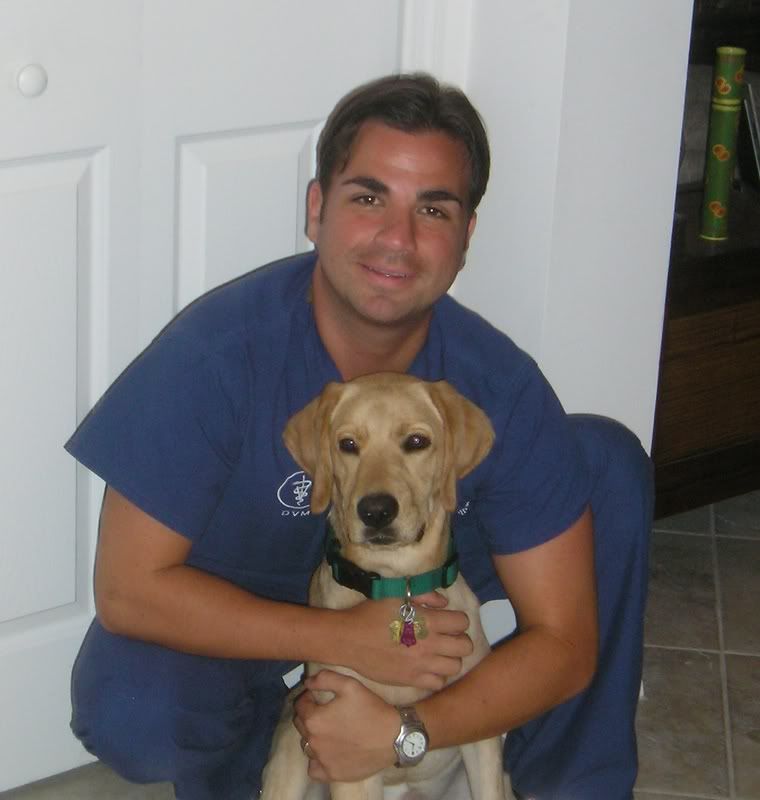
Six months ago, in memory of my late beloved Labrador Retriever, Tiffany, I started a charity fund in her name, that would pay for health care for pets of the less fortunate whose lives are threatened by treatable injury or disease. Fund raising has been a combination of internet donation and waiting room collection box, waiting room candy machines, book sales, and yard and bake sales.
Fund raising has been slow going, and weather has until recently hampered our ability to have outdoor yards sales. Nonetheless, the fund finally reached a point that it could begin to be used sparingly, just in time for a case that epitomized the situations that Tiffany's Fund was intended for.
This past Tuesday afternoon, in walked Lady, a 4 year old Labrador Retriever, Doberman Pinscher cross, one of our cherished patients because of her extraordinarily sweet, gentle disposition, as well as her remarkable beauty (she wears the best features of both breeds that she's comprised of). Her owners are an elderly couple that do not have much money, but never hesitate to keep Lady up to date on her yearly visits and preventives.
On this particular day, Lady was very sick, having thrown up a sock the previous night, and hadn't stopped throwing up since. She was listless, severely dehydrated, and very painful in the abdomen. X-rays and a radiographic technique known as upper GI series, we ascertained that Lady likely had additional foreign bodies obstructing her bowels, a situation that would lead to certain death if left untreated.
When I presented the estimate for the necessary surgery and intensive care hospitalization to the owners, Lady's father agonizingly told me that he could not afford the surgery and would have to put her down. At this point, I did not offer Tiffany's Fund money to help, since we have three main rules for considering candidates for Tiffany's Fund. These criteria are in place to weed out those seeking to misrepresent themselves and fraudulently, take advantage of our fund that we work very hard to raise money for.
(1) The patient's condition must be potentially life threatening. (2) The client must not come in asking for the fund, or indicate in any way that they brought their pet to us specifically because of the fund. (3) The client must apply for and be denied Care Credit, a third party, interest free medical lending company we offer as a payment option. Of course, there are subjective assessments that my experienced technicians and I consider, that one gets a feel for the quality of a pet owner from years of experience (e.g., don't tell me you can't afford health care for your pet, when you show in a BMW or walk in with a Louis Vuitton purse).
In tears, Lady's elderly father told me that he would likely get accepted for Care Credit since he retains a good credit rating, but living on a fixed income of $1200 per month, he refused get himself into debt that he and his wife would have to starve in order to pay back, even without interest. He agonizingly told me that he adored his dog, but he could not justify putting his wife in harms way by spending money they don't have.
Seeing that this dog was always well cared for, and knowing this sweet old couple for 4 years, I knew that Lady's father was being sincere. As such, I waved the Care Credit criteria and offered our fund to pay for Lady's treatment.
On abdominal exploratory surgery, I found that there were two socks jammed in her small intestine, causing obstruction and hemorrhage. I removed the obstruction via enterotomy, flushed her abdomen, closed her incision, then treated her aggressively with IV fluids, antibiotics, GI protectants, and narcotic pain management. Lady went home yesterday eating, in good spirits, her pain under control, and ecstatic to be reunited with her owners, a sentiment that was mirrored by her owners. I got to experience the joy of a life saved through the inspiration and memory of the greatest friend I ever had. It is my goal to ensure that this is only the first of many to come.
If you would like to read more about Tiffany's Fund, and/or wish to contribute, please visit the Tiffany's Fund page of my hospital's website at:
http://www.maybeckvet.com/tiffanysfund.html
Roger Welton, DVM
Founder, Web-DVM
Sunday, October 26, 2008

Monday, October 20, 2008
Owners, Please Warn Your Vet If Your Pet Bites!
To most people, it would seem logical that if one's dog or cat has aggressive or fear biting tendencies, that one would warn the veterinarian, a complete stranger performing sometimes uncomfortable clinical tasks on a patient, that he/she should be careful. Yet, at least a few times a week, I find myself finding out that a new patient is aggressive the hard way, getting bitten, scratched, lunged at, or all of the above. And when any of the above happens, many of these owners clearly has previous knowledge of their animals' aggression, as evidenced by their statements immediately following the episode, such as, "Oh yeah, he's always nasty to vets."
In response to this, I always say, "In the future, please warn us about a pet's potential for aggression, or people can get badly hurt." Staying politically correct like this requires a great deal of restraint on my part, as I often am seething with anger inside, especially following an exceptionally dangerous experience. Under these circumstances, I sometimes have the impulse to just throw the pet owner out of my office and ban him/her from the clinic, or to at least say, "How about a warning, you moron!" Thankfully, better tact typically prevails.
I do not know why some pet owners think that they do not need to warn veterinarians, assistants, and veterinary technicians about a pet's aggressive tendencies. I have speculated that some naively think that our veterinary training has endowed us with Dog Whisperer like abilities to make animals readily cooperate. In some cases, it has seemed that some pet owners are in denial that their pet has the potential to inflict harm on people. In a rare few instances, I even experience owners that find it amusing or cute that their animals have attacked and that failed to warn us (under these circumstances, all political correctness goes out the window).
To pet owners, please let me be clear that we do not possess a divine ability to make your pets like us. In fact, that opposite is true. When your pets see us, we smell like many other animals unfamiliar to your pet, that we have handled throughout the day. We are strangers to your pet, instilling an automatic sense of trepidation in fearful animals, but made worse by the fact that we do scary things to patients, like shine bright lights in their eyes, palpate abdomens, clean ears, trim nails, administer injections, and take temperatures.
If you have seen your pet act aggressively and do not warn us out of denial or wishful thinking that your aggressive pet may do better with a new vet, understand that your denial or wish that your pet may come around this time, can get people seriously injured. For those of you that thinks it is amusing or cute to see your vet attacked by your aggressive pet, talk to my first employer who had her lower lip bitten off by a rottweiler and required skin grafting and 4 surgeries to offer some semblance of cosmetic integrity. Ask her how cute her experience was!
Thursday, October 9, 2008
Animal Hoarding Revealed
About a year ago, a client of my clinic brought in a little chihuahua that was in a very disturbing state. The little dog had come from a home that my client's brother had been contracted to make some repairs. This gentleman was appalled at the condition of the home inside, where he witnessed at least 40 chihuahuas roaming, interbreeding, and eliminating at will throughout the house. The dogs were flea infested, dirty, and many of them fraught with varying degrees of injuries, ailments, and deformities.
My client ended up with the little chihuahua that she brought into my office because her brother found this little chihuahua particularly suffering, and made the decision to whisk the dog away without the owner's knowledge. Specifically, the dog was blind in both eyes due to untreated ocular infections and/or trauma, a badly deformed and shortened right front arm (the likely result of inbreeding), and severe flea infestation complete with skin infections, hair loss, and severe discomfort that typically accompany fleas.
We ultimately had to remove both eyes surgically as they were damaged beyond salvage. The skin cleared with antibiotics, medicinal baths and flea control. There was no beneficial options for the deformed little leg, but the dog managed to ambulate effectively nonetheless. This little dog miraculously lives comfortably, eats enthusiastically, and happily plays with my clients other animals - it was a happy ending for Mattie (as she was affectionately named by my client's loving family). As for the owner of these numerous dogs living in filth and squalor, she was reported to animal control, who ultimately had the dogs taken from the home and the owner dealt with legally.
The owner of these little dogs is what is known in animal law terms as an animal hoarder. Recent reports of animal hoarders in my local news reminded of the case of Mattie, and prompted me to raise awareness to my readers to learn to recognize these types of people.
Animal hoarders are distinguished from a people that keep an unusually large number of pets that care for them properly, as they are distinguished from animal breeders who have my animals as a nature of their business (who also care for the animals properly). According to one study, the distinguishing feature is that a hoarder, "fails to provide the animals with adequate food, water, sanitation, and veterinary care, and . . . is in denial about this inability to provide adequate care."
Animal hoarding of often goes hand in and with other compulsive hoarding behaviors, or could be part of a severe underlying obsessive compulsive personality disorder. Alternately, animal hoarding could be the result of addiction, dementia, or delusions. Being commonly the result of mental disorders, hoarders often have homes that are poorly maintained, dirty, and in many cases seemingly falling apart.
Although it is typically not the intention of an animal hoarder to harm the animals, the hoarder is incapable of recognizing the suffering that their behavior causes the animals they recklessly collect. Animal hoarding is therefore considered a form of animal cruelty, as is clearly evidenced in Mattie's case.
I implore all citizens to be aware of the signs of potential animal hoarders and report them to the authorities if animal hoarding is suspected in your communities.
Roger Welton, DVM
Founder, Web-DVM
Friday, October 3, 2008
Web Poll Suggests 32% of Pet Owners Not Interested In Preventive Health Care
A recent web poll conducted by this blog's parent site, Web-DVM.net, indicated that 68% of dog and/or cat owners participated in regular preventive health care for their pets, while 32% did not. The poll defined regular preventive health care as updating vaccines, heartworm screening (dogs), examination, and stool analysis, performed at least once yearly.
The implications of this alarmingly high number of household pets that are not kept on some preventive health care regimen, are many. For dogs, this means that a significant percentage are not protected from serious canine diseases, such as distemper, parvo, and heartworm disease. For cats, this means that many are not protected from serious feline disease, such as panleukopenia and feline leukemia.
For both species, forgoing updated rabies vaccine, not only risks a deadly nervous system disease for animals, but also for people, as rabies is contagious to people and other mammalian species. This human health risk potential makes failing to keep a pet with an current rabies vaccine is a violation of the law in most municipalities.
Also for both species, not performing regular stool analysis leaves the animal at risk for parasites, a situation that will exert ill effects on the pet, but also can pose a significant risk to small children in contact with the pet. While children are not the definitive hosts of these parasites, following infection, their naive immune systems can allow the progression of the life cycle of some parasites to reach a larval stage that migrates through the skin and eyes, leading to potential skin rashes and blindness, respectively.
Many people I come across that come to see me only when their pets are sick or injured, but not ever for preventive health care, justify their position by stating that they don't ever go to the doctor and they're fine. What I try to explain to people of this ilk is that people are better equipped go extended periods of time without check-ups and health screening for two important reasons. First, most of us do not engage in exceptionally risky behavior as pets do, such as sniffing or rolling in decaying organic matter, drinking out of puddles or other stagnant water, fighting with or eating wildlife, etc. Second, one year of a dog's or cat's life is a much larger percentage of an animals life when compared to a human, leaving proportionally alot more that can adversely effect health in this time period.
Denying pets the benefits of even basic preventive health care leaves them susceptible to illness, often leads to chronic poor health and diminished quality of life, and can even place families and communities in danger. For this reason, people who cannnot afford preventive health care for their pets should seriously reconsider pet ownership until they are in a better financial position to provide pets with at least minimal preventive health care. For those who simply do not care to engage in preventive health care for their pets, display apathy, irresponsibility, or both, either of which alone make them bad candidates for pet ownership in the first place.
Roger Welton, DVM
Founder, Web-DVM
Thursday, October 2, 2008
Way To Step Up For Animals, Body Shop
Regularly observing or learning of unconsionable acts of animal neglect, abuse, and cruelty in the United States of America, a country that is very developed and for the most part is comprised of a compassionate citizenry, I have often wondered about the potential plight of animals in less developed and/or antiquated countries. This has led me to often shudder at the thought of the treatment of animals in places where there is little regard for even human rights.
As such, I was so very pleased to learn of a report by The Wall Street Journal's MarketWatch.com, that The Body Shop, a natural health and beauty product chain, has partnered with The World Society for the Protection of Animals (WSPA) in raising awareness to sign sign a petition in support of a Universal Declaration on Animal Welfare. The "Make Yourself Beautiful Campaign", as it is called, will run from October 4-10, and for the duration of October at The Body Shop stores throughout Canada and the USA. During this time, customers will be encouraged to sign an online petition in support of the Declaration on the website www.makeyourselfbeautiful.org. The website also encourages individuals to "surround themselves with beautiful people" by getting their friends and family to sign as well.
The Universal Declaration on Animal Welfare is an agreement between people and countries that recognizes that animals can experience pain and suffering, and that working toward ensuring that the lives of animals are free of pain and suffering needs to be a top priority. Specifically, The Universal Declaration on Animal Welfare would help animals of the world by, as directly quoted from MarketWatch.com:
"-Raising the status of animal welfare as an international issue.
-Encouraging governments to establish or improve existing national animal
welfare legislation.
-Inspiring positive change in public attitudes and actions towards
animals."
A campaign of awareness alone may not seem adequately proactive, but remember the old proverb, "a journey of 1000 miles begins with the first step," and spreading awareness is an effective and neccesary first step. I encourage all my readers in joining the Body Shop in their mission and signing the petition.
Roger Welton, DVM
Founder, Web-DVM
Monday, September 29, 2008
University of Minnesota Discovers Gene Responsible for Excercise Induced Collapse in Dogs
The Minneapolis based StarTribune.com reported yesterday that researchers at the University of Minnesota have identified the gene mutation responsible for Excercise Induced Collapse (EIC) in Labrador Retrievers. EIC, whose signs include wobbliness sometimes progressing to collapse in the rear legs, sometimes loss of muscle control spreading to the rear legs as well, and in rare cases, death, affects about 3-5 percent of Labs.
A mutation of a gene, known as dynamin 1, produces a protein involved in the chemical signaling system between nerves that allows the brain to control muscle movement. The authors of the study believe that the mutant protein hinders the ability to send signals between nerves, suggesting that EIC occurs because the signaling system can't keep up with the rapid firing required during intense exercise. Like other recessive genetic disorders, 2 copies of the gene are required to exert a clinical effect.
Previously, veterinarians had a significant challenge in arriving at a diagnosis of EIC, because other causes for collapse had to be ruled out. According to StarTribune.com, however, this disease can now be detected with a simple and inexpensive DNA test.
The implications of this discovery are very important. Since all mammals carry dynamin 1, learning more about how the gene's protein functions may potentially contribute to understanding disorders in other mammals, including humans. Regarding animal health primarily, not only can a diagnosis of EIC now be attained much more easily, but breeders can now test potential breeding animals for carrying the mutant gene. This type of genetic screening can go a long way to significantly lowering the incidence of this disease in Labs.
Roger Welton, DVM
Founder, Web-DVM
Wednesday, September 24, 2008
Dead Animal Prank Not So Funny
On September 20, 2008, KTVU.com reported that a 20 year old in Dublin, California was arrested for, and confessed to a prank that involved his stealing 2 dead cats and a dead dog from the morgue of a nearby animal hospital, and stuffing them in three yet to be assigned lockers in the local high school.
The first body was discovered that morning, according to police. The second body was found the first week of September, followed by the third body on Sept. 9th, after a smell was reported coming from a locker. 20 year old Brian Goett was shortly later arrested for suspicion of grand theft, tampering with school property, and improper disposal of animals. Goet has no affiliation with Dublin High School, and no motivation for his actions have been revealed.
As a veterinarian who deals with pet loss to death by natural causes or euthanasia due to prolonged suffering, I regularly see first hand the grief that clients experience as a result of the loss of their beloved companions. As a pet owner for many years, I have endured this same grief when I have had to part with my own pets. For those of us who feel our pets loss as more than just the death of an animal, but as the loss of a cherished family member, we wish for the remains to be treated with the same respect and dignity as our human family members - I have my late yellow labs ashes in a tower with an engraved plaque and her picture prominently displayed in my living room. For any of us to know that our deceased family pets were treated like in the manner that Brian Goet treated these deceased pets would be most distressing and compound the already present sadness of loss.
Although no one in the naivety of youth can claim to have been immune to occasionally exercising poor judgement and not thinking something through before acting, I would expect better from a 20 year old who should have by now left high school far behind. And while it is not my hope that the ramifications of his actions permanently scar this young man's life, I hope that his penalties will be sufficient leave an impression on him that his actions were harmful on many levels and even border on sociopathic. Most importantly, I hope that in addition to sincerely regretting breaking and entering, theft, and creating potential human health hazards, that the young man also realizes and feels regret for the fact that he desecrated the remains of what were likely cherished family members.
Roger L. Welton, DVM
Founder, WEB-DVM.net
Subscribe to:
Posts (Atom)