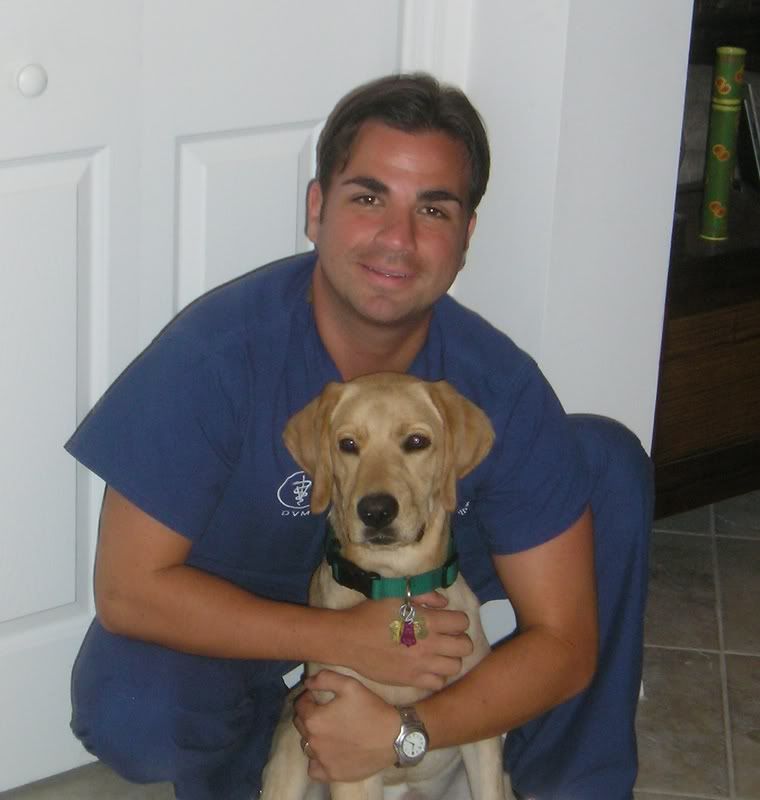
Hey folks, I am not posting anything new this week, as I dedicated the early part of the week preparing for my interview on the Blog Talk Radio show, "Win Without Competing," with host and author, Dr. Arlene Barro. She asked me some really neat questions about my life's path that got me to where I am and what I am doing today.
The broadcast aired live earlier this evening, but you can catch the archived version at this link, any time after 10:00 PM Eastern Standard Time tonight at this address:
http://www.blogtalkradio.com/Dr-Arlene-Barro-/2009/08/13/WIN-Without-Competing-with-Dr-Arlene-Barro
Hope you enjoy it. I will be back next week with a new broadcast and blog post!
Roge Welton, DVM
Founder, Web-DVM.net
Wednesday, August 12, 2009

Friday, August 7, 2009
Infant kidnapped by family dog home and in stable condition
A very relieving happy ending for the Smith family of Kentucky seems imminent, with the release of their infant son, injured after having been carried off into the woods by the family dog. But before expanding on this story and topic of my personal comment on this week's Pet Chat Radio, a quick reminder of my upcoming appearance on Dr. Arlene Barro's talk radio show, Win Without Competing, my role will have changed, as I will be the one being interviewed live by host, Dr. Barro. The live broadcast will be Wednesday, August 12, 2009, and you can listen to it at:
http://www.blogtalkradio.com/Dr-Arlene-Barro-/2009/08/13/WIN-Without-Competing-with-Dr-Arlene-Barro
Moving along to my personal comment this week, which is related to the infant kidnapping by the family dog in Kentucky, using the same terminology that most media outlets are using in reference to this story. If you are not familiar with this story, you may access my original report on this story from the Archived Broadcast section of Pet Chat Radio's home page, and select the July 24, 2009 broadcast.
The truth is, this was not a kidnapping, but a dog simply acting in a manner of instinct, which was to carry her “pup” off to a place to care for it. With a human infant not being a puppy of course, she inadvertently caused this infant great harm. Now that we know that the infant is home and expected to make a full recovery, I feel more comfortable about commenting on the situation.
Let me begin by stating that my thoughts and prayers go out to the Smith family, that their baby does in fact make a full recovery and goes on to live a happy, care free life, and that the family can pull together to put this traumatic ordeal to rest. As a parent of a toddler, I know the love one feels for a child, and know the fear and stress one feels when a child is sick or injured.
Moving forward, while I am certain that the Smiths learned a painful yet valuable lesson here, we should all take away some lessons as well. First and foremost, is that, no matter how people like and part of the family our pets may be, instinct sometimes takes over, and that instinct can be dangerous to small children. As such, infants, toddlers, and small children should never be left unsupervised with a family pet, even for a second. No pet should ever have free access to a small child when a parent is not around to control and supervise the situation.
When my wife and I brought our little baby Austin home 14 months ago, when he spent his first 5 months sleeping in the bassinet attached to the side of our bed, no pets were allowed in the bedroom, for fear that a curious dog may jostle the bassinet, or a curious cat may get in bed with the boy. Once he moved to his nursery, he slept and continues to sleep with the door closed, and with a child safety device on the door handle so a a cat cannot turn the handle and let himself in – yes, our Devon Rex, Mo taught himself how to let himself into any room in the house by jumping up and pulling down the handle with his paw – very funny, amusing, and frankly, quite impressive on the part of our cat, but not allowed or acceptable when it comes to him potentially jumping into the crib with our little boy.
Play between Austin and the dogs is always closely supervised so that we may quickly step in, in the event that a pet acts inappropriately toward the toddler, or if the toddler starts to get too rough or grabby with the pets. When we cannot actively monitor the situation, the baby either plays in his play pen, or the dogs are locked out of the living room with baby gates.
These are precautions every household with pets and small children that interact should take. One lapse of judgment or attention, can lead to dangerous, even tragic circumstances, I don’t care how perfectly gentle your think you dog is.
The other lesson I think we should take from this incident, is that wolves and wolf hybrids should not be allowed to be kept as pets, and certainly should not ever be purposefully bred. Let me be clear that while the domestic dog was descended from the wolf, wolves are NOT dogs, as much as they may seem to be. They have a deeply ingrained wild instinct, making them difficult to train, ready engage in testing with dominance behavior, unpredictable, and often acting on strong instinct, as was the case with Dakota the family dog, herself a wolf hybrid. For these reasons keeping wolves and wolf hybrids as pets is illegal in many states, and for good reason.
That said, it is not the fault of these animals that they were born as they and with us now, and these animals deserve guardianship. However, potential homes for these dogs should be carefully scrutinized, with potential guardians interested in rescuing one of these dogs well versed in canine behavior, and live in a home with no young children, which is the type of home that Dakota will end up in.
Roger Welton, DVM
Founder, Web-DVM
http://www.blogtalkradio.com/Dr-Arlene-Barro-/2009/08/13/WIN-Without-Competing-with-Dr-Arlene-Barro
Moving along to my personal comment this week, which is related to the infant kidnapping by the family dog in Kentucky, using the same terminology that most media outlets are using in reference to this story. If you are not familiar with this story, you may access my original report on this story from the Archived Broadcast section of Pet Chat Radio's home page, and select the July 24, 2009 broadcast.
The truth is, this was not a kidnapping, but a dog simply acting in a manner of instinct, which was to carry her “pup” off to a place to care for it. With a human infant not being a puppy of course, she inadvertently caused this infant great harm. Now that we know that the infant is home and expected to make a full recovery, I feel more comfortable about commenting on the situation.
Let me begin by stating that my thoughts and prayers go out to the Smith family, that their baby does in fact make a full recovery and goes on to live a happy, care free life, and that the family can pull together to put this traumatic ordeal to rest. As a parent of a toddler, I know the love one feels for a child, and know the fear and stress one feels when a child is sick or injured.
Moving forward, while I am certain that the Smiths learned a painful yet valuable lesson here, we should all take away some lessons as well. First and foremost, is that, no matter how people like and part of the family our pets may be, instinct sometimes takes over, and that instinct can be dangerous to small children. As such, infants, toddlers, and small children should never be left unsupervised with a family pet, even for a second. No pet should ever have free access to a small child when a parent is not around to control and supervise the situation.
When my wife and I brought our little baby Austin home 14 months ago, when he spent his first 5 months sleeping in the bassinet attached to the side of our bed, no pets were allowed in the bedroom, for fear that a curious dog may jostle the bassinet, or a curious cat may get in bed with the boy. Once he moved to his nursery, he slept and continues to sleep with the door closed, and with a child safety device on the door handle so a a cat cannot turn the handle and let himself in – yes, our Devon Rex, Mo taught himself how to let himself into any room in the house by jumping up and pulling down the handle with his paw – very funny, amusing, and frankly, quite impressive on the part of our cat, but not allowed or acceptable when it comes to him potentially jumping into the crib with our little boy.
Play between Austin and the dogs is always closely supervised so that we may quickly step in, in the event that a pet acts inappropriately toward the toddler, or if the toddler starts to get too rough or grabby with the pets. When we cannot actively monitor the situation, the baby either plays in his play pen, or the dogs are locked out of the living room with baby gates.
These are precautions every household with pets and small children that interact should take. One lapse of judgment or attention, can lead to dangerous, even tragic circumstances, I don’t care how perfectly gentle your think you dog is.
The other lesson I think we should take from this incident, is that wolves and wolf hybrids should not be allowed to be kept as pets, and certainly should not ever be purposefully bred. Let me be clear that while the domestic dog was descended from the wolf, wolves are NOT dogs, as much as they may seem to be. They have a deeply ingrained wild instinct, making them difficult to train, ready engage in testing with dominance behavior, unpredictable, and often acting on strong instinct, as was the case with Dakota the family dog, herself a wolf hybrid. For these reasons keeping wolves and wolf hybrids as pets is illegal in many states, and for good reason.
That said, it is not the fault of these animals that they were born as they and with us now, and these animals deserve guardianship. However, potential homes for these dogs should be carefully scrutinized, with potential guardians interested in rescuing one of these dogs well versed in canine behavior, and live in a home with no young children, which is the type of home that Dakota will end up in.
Roger Welton, DVM
Founder, Web-DVM
Tuesday, July 21, 2009
Florida's Gentle Giant
Before addressing the main topic of this week's Pet Chat Radio personal comment and subject of this week's blog entry, I want to first mention that our special guest this week on Pet Chat Radio is Rob Rosenberg, pharmaceutical sales representative for a large veterinary pharmaceutical company. In my interview with Rob, he shares some very interesting insights into this prevalent aspect of the veterinary industry. Also, I wanted to give ample notice for my appearance on Dr. Arlene Barro's talk radio show, Win Without Competing, my role will have changed, as I will be the one being interviewed live by host, Dr. Barro. The live broadcast will be Wednesday, August 12, 2009, and you can listen to it at:
http://www.blogtalkradio.com/Dr-Arlene-Barro-/2009/08/13/WIN-Without-Competing-with-Dr-Arlene-Barro
On to my personal comment, as I have mentioned, I was just vacationing in the Florida Keys, the biggest enjoyment of which my wife and I derive from the natural beauty of the landscape and diverse and beautiful wildlife. From snorkeling the breathtaking coral reefs and taking in the diverse sea life, to kayaking the mangroves and feeding the tarpon at Robby's Marina, it is the unique and diverse wildlife that keeps us going back (of course, the charming resorts, great food, and gorgeous sunsets don't hurt). Of all the wildlife we see in the Keys and even up here occasionally in the Space coast, none are more captivating than the Manatee.

These gentle giants, and Florida's official state marine mammals, are actually a large aquatic relative of the elephant. They are grayish brown in color with medium sized, black, expressive eyes and have thick, wrinkled skin on which there is often a growth of algae. Their front flippers help them steer or sometimes crawl through shallow water. They also have powerful flat tails that help propel them through the water. Despite their lack of outer ears, manatees seem to hear quite well.
Manatees can be found typically in the warm waters of shallow rivers, bays, estuaries and coastal waters, rarely going into water that is below 68 degrees Fahrenheit. Well known for their gentle, slow-moving nature, manatees have also been known to body surf or barrel roll when playing, and often are playful and curious with people, commonly swimming up to boats, kayaks and even swimmers for up close interaction.
As adults, Manatees are about 10-12 feet long and weigh between 1500 - 1800 pounds, supporting this bulk with an exclusive herbivorous diet of marine and freshwater plants. Their life span in the wild is about 50 - 60 years of age. The largest population of Manatees is in Florida, where they number about 3000.
Unfortunately this subtropical treasure faces many threats, including destruction and degradation of their coastal and freshwater habitats. The leading known cause of death is by boat strikes; propellers and hulls can inflict serious or mortal wounds. Most manatees have a pattern of scars on their backs or tails after having survived collisions with boats. Scientists often use these patterns to identify individuals. They have also been found crushed or drowned in flood-control gates and suffer harm from exposure to toxic red tide. In addition, a large number of manatees die from unknown causes each year.
Fortunately, although numbers have gradually recovered in recent years, Manatees remain a protected species, listed still as a federal endangered species.
Just one glance at one of these huge yet surprisingly graceful, gentle creatures, and one's heart is instantly endeared to them. I encourage all of my blog readers and radio show listeners to take interest in their continued protection and preservation. To find out how you can do your small part to help this magnificent animal, visit the Save the Manatee Club at:
http://www.savethemanatee.org/
Roger Welton, DVM
Founder, Web-DVM
http://www.blogtalkradio.com/Dr-Arlene-Barro-/2009/08/13/WIN-Without-Competing-with-Dr-Arlene-Barro
On to my personal comment, as I have mentioned, I was just vacationing in the Florida Keys, the biggest enjoyment of which my wife and I derive from the natural beauty of the landscape and diverse and beautiful wildlife. From snorkeling the breathtaking coral reefs and taking in the diverse sea life, to kayaking the mangroves and feeding the tarpon at Robby's Marina, it is the unique and diverse wildlife that keeps us going back (of course, the charming resorts, great food, and gorgeous sunsets don't hurt). Of all the wildlife we see in the Keys and even up here occasionally in the Space coast, none are more captivating than the Manatee.

These gentle giants, and Florida's official state marine mammals, are actually a large aquatic relative of the elephant. They are grayish brown in color with medium sized, black, expressive eyes and have thick, wrinkled skin on which there is often a growth of algae. Their front flippers help them steer or sometimes crawl through shallow water. They also have powerful flat tails that help propel them through the water. Despite their lack of outer ears, manatees seem to hear quite well.
Manatees can be found typically in the warm waters of shallow rivers, bays, estuaries and coastal waters, rarely going into water that is below 68 degrees Fahrenheit. Well known for their gentle, slow-moving nature, manatees have also been known to body surf or barrel roll when playing, and often are playful and curious with people, commonly swimming up to boats, kayaks and even swimmers for up close interaction.
As adults, Manatees are about 10-12 feet long and weigh between 1500 - 1800 pounds, supporting this bulk with an exclusive herbivorous diet of marine and freshwater plants. Their life span in the wild is about 50 - 60 years of age. The largest population of Manatees is in Florida, where they number about 3000.
Unfortunately this subtropical treasure faces many threats, including destruction and degradation of their coastal and freshwater habitats. The leading known cause of death is by boat strikes; propellers and hulls can inflict serious or mortal wounds. Most manatees have a pattern of scars on their backs or tails after having survived collisions with boats. Scientists often use these patterns to identify individuals. They have also been found crushed or drowned in flood-control gates and suffer harm from exposure to toxic red tide. In addition, a large number of manatees die from unknown causes each year.
Fortunately, although numbers have gradually recovered in recent years, Manatees remain a protected species, listed still as a federal endangered species.
Just one glance at one of these huge yet surprisingly graceful, gentle creatures, and one's heart is instantly endeared to them. I encourage all of my blog readers and radio show listeners to take interest in their continued protection and preservation. To find out how you can do your small part to help this magnificent animal, visit the Save the Manatee Club at:
http://www.savethemanatee.org/
Roger Welton, DVM
Founder, Web-DVM
Thursday, July 9, 2009
Alaska's Wildlife Can Breathe A Sigh Of Relief - Hopefully?
Before delving into my personal comment for this week, I want to remind our readers to listen to this week's Pet Chat Radio broadcast, which begins with a wonderfully informative interview with master groomer, Heather Shultz, who kindly took the time to offer invaluable insights into the art and career of pet grooming. There is so much more to this profession than most realize, as Heather so eloquently explains in our interview!
Back to my personal comment and subject of this post, I just wanted to touch on Sarah Palin’s resignation. While this is a political story really, and politics have little place in our broadcast and this blog (we learned the hard way during this past election!), this does pertain to animals directly, and that is, apart from partisan politics, from a wildlife standpoint, perhaps wildlife advocates of Alaska can breathe a bit easier with this revelation. From a wildlife perspective strictly, her policies have been abysmal at best.
As reported by a September 4, 2008 Associated Press article titled, "Environmentalists say Palin's record on wildlife are as harsh as Alaska itself," Sarah Palin's policies and record clearly illustrate little regard for wildlife and the environment. Beginning with her time at the National Governors Association conference spent primarily making her case to Interior Secretary Dirk Kempthorne against classifying the polar bear as a threatened species, Sarah Palin has continually maintained troublingly dismissive environmental and wildlife policies. Some months later, she once again confronted Dirk Kempthorne, arguing against even the Bush administration that they, "didn't use the best science in concluding that without further protection, the polar bear faces eventual extinction because of disappearing sea ice as the result of global warming."
During her months of governor of Alaska, Palin had opposed federal marine scientists who concluded that the Cook Inlet Beluga Whale needs protection under the federal Endangered Species Act. Most appallingly, Palin has defended the right of Alaska to shoot wolves from the air for the benefit of boosting the populations of moose and caribou herds - not for the sake of the moose and caribou, but for the sole purpose of leaving more live moose and caribou for the human sport hunters to kill! Interestingly, this is a view that is contrary to that of her former running mate John McCain. Finally, Palin remains skeptical that human created greenhouse emissions are responsible for the dramatic acceleration of global warming in this century.
As a result of her harsh environmental and wildlife policies, environmentalists have nicknamed Palin the "Killa from Wasilla," and John Toppenberg, the director of the Alaska Wildlife Alliance, has said that, "Her philosophy from our perspective is cut, kill, dig and drill," and that she is "in the Stone Age of wildlife management and is very opposed to utilizing accepted science."
Now of course, I know nothing of her replacement’s wildlife policies and it is difficult to envision worse, we have to retain some feeling of at least there is the potential for respite, that Alaska’s wildlife powers that be will at least gather or begin to regain some reverence for one of our nation’s most precious wildlife havens.
Roger Welton, DVM
Founder, Web-DVM
Back to my personal comment and subject of this post, I just wanted to touch on Sarah Palin’s resignation. While this is a political story really, and politics have little place in our broadcast and this blog (we learned the hard way during this past election!), this does pertain to animals directly, and that is, apart from partisan politics, from a wildlife standpoint, perhaps wildlife advocates of Alaska can breathe a bit easier with this revelation. From a wildlife perspective strictly, her policies have been abysmal at best.
As reported by a September 4, 2008 Associated Press article titled, "Environmentalists say Palin's record on wildlife are as harsh as Alaska itself," Sarah Palin's policies and record clearly illustrate little regard for wildlife and the environment. Beginning with her time at the National Governors Association conference spent primarily making her case to Interior Secretary Dirk Kempthorne against classifying the polar bear as a threatened species, Sarah Palin has continually maintained troublingly dismissive environmental and wildlife policies. Some months later, she once again confronted Dirk Kempthorne, arguing against even the Bush administration that they, "didn't use the best science in concluding that without further protection, the polar bear faces eventual extinction because of disappearing sea ice as the result of global warming."
During her months of governor of Alaska, Palin had opposed federal marine scientists who concluded that the Cook Inlet Beluga Whale needs protection under the federal Endangered Species Act. Most appallingly, Palin has defended the right of Alaska to shoot wolves from the air for the benefit of boosting the populations of moose and caribou herds - not for the sake of the moose and caribou, but for the sole purpose of leaving more live moose and caribou for the human sport hunters to kill! Interestingly, this is a view that is contrary to that of her former running mate John McCain. Finally, Palin remains skeptical that human created greenhouse emissions are responsible for the dramatic acceleration of global warming in this century.
As a result of her harsh environmental and wildlife policies, environmentalists have nicknamed Palin the "Killa from Wasilla," and John Toppenberg, the director of the Alaska Wildlife Alliance, has said that, "Her philosophy from our perspective is cut, kill, dig and drill," and that she is "in the Stone Age of wildlife management and is very opposed to utilizing accepted science."
Now of course, I know nothing of her replacement’s wildlife policies and it is difficult to envision worse, we have to retain some feeling of at least there is the potential for respite, that Alaska’s wildlife powers that be will at least gather or begin to regain some reverence for one of our nation’s most precious wildlife havens.
Roger Welton, DVM
Founder, Web-DVM
Thursday, July 2, 2009
Veterinary Technician: The Unsung Hero of Veterinary Medicine
In my personal comment and subject of my blog post today, I would like to expand a bit on my Pet Chat Radio interview earlier with the lovely certified veterinary technician, Melissa Welton. She exemplified just how invaluable technicians are to a veterinary practice from her own personal experience in teh profession. If you have not yet had the opportunity to hear the interview, I strongly recommend it.
Most veterinarians understand the value of good technicians, most treating them and regarding them with the respect they deserve. Many clients also understand how important certified veterinary technicians are to animal health care, taking the time acknowledge them with verbal “thank you” and often “thank you” cards, but very often, the credit for having saved a life or resolved disease is directed solely at the attending veterinarian. Yet the technicians rarely are affected by this, moving on, and performing their essential tasks with the reward they need: the personal satisfaction of knowing that they work in the field that they love, and that they play a big role day in and day out, in doing their part to better the health of people’s beloved house pets.
To get a better understanding of how important technicians are, just refer to the following small glimpse of what my technicians do for me.
When I come in the morning, all treatments of in-hospital animals have ready been complete by the techs. Hospital runs have been cleaned, the animals walked, fed, vitals have been taken, and the treating technicians have a report for me on each patient.
In addition to this, technicians have admitted, performed presurgical vitals, run all pertinent labwork, and reported to me the findings so I can go ahead with my recommendation for premedication, which they then implement. Prior to surgery, technicians, clip and scrub the patient’s surgical site, induce the patient, place the tracheal tube, start gas anesthesia, then monitor anesthesia throughout the procedure. If the procedure is a dental prophylaxis, they perform the professional cleaning, check for pockets and other intraoral lesions, then alert me to assess whether further dental work needs to be done. For procedures that require another set of hands, technicians scrub in to assist me.
During appointments, technicians perform all labwork by my order, freeing me up to keep up with my paper work and see more patients. During down time, technicians sift through all faxed labwork, place them in the proper medical files, then put them in my box for me to interpret and call the clients. They also process and examine all stool samples for parasites, alert me about positive results, then dispense the necessary medication and call the client with a diagnosis and to alert that medication is waiting for the pet to be picked up. My most senior technician spends her down time logging the controlled drugs, keeping the hospital OSHA compliant, and ordering inventory.
At the end of the day, technicians discharge the patient, dispense medications, and go over discharge instructions with the client.
I am sure there is plenty more that they do that is escaping me at this very moment, but I think the point is clear how important technicians are to a hospital. While veterinarians are the nucleus of the practice that bear the primary patient responsibility, we could not do what we do, as well as we do, without our dedicated and hard working veterinary technicians.
Roger Welton, DVM
Founder, Web-DVM
Most veterinarians understand the value of good technicians, most treating them and regarding them with the respect they deserve. Many clients also understand how important certified veterinary technicians are to animal health care, taking the time acknowledge them with verbal “thank you” and often “thank you” cards, but very often, the credit for having saved a life or resolved disease is directed solely at the attending veterinarian. Yet the technicians rarely are affected by this, moving on, and performing their essential tasks with the reward they need: the personal satisfaction of knowing that they work in the field that they love, and that they play a big role day in and day out, in doing their part to better the health of people’s beloved house pets.
To get a better understanding of how important technicians are, just refer to the following small glimpse of what my technicians do for me.
When I come in the morning, all treatments of in-hospital animals have ready been complete by the techs. Hospital runs have been cleaned, the animals walked, fed, vitals have been taken, and the treating technicians have a report for me on each patient.
In addition to this, technicians have admitted, performed presurgical vitals, run all pertinent labwork, and reported to me the findings so I can go ahead with my recommendation for premedication, which they then implement. Prior to surgery, technicians, clip and scrub the patient’s surgical site, induce the patient, place the tracheal tube, start gas anesthesia, then monitor anesthesia throughout the procedure. If the procedure is a dental prophylaxis, they perform the professional cleaning, check for pockets and other intraoral lesions, then alert me to assess whether further dental work needs to be done. For procedures that require another set of hands, technicians scrub in to assist me.
During appointments, technicians perform all labwork by my order, freeing me up to keep up with my paper work and see more patients. During down time, technicians sift through all faxed labwork, place them in the proper medical files, then put them in my box for me to interpret and call the clients. They also process and examine all stool samples for parasites, alert me about positive results, then dispense the necessary medication and call the client with a diagnosis and to alert that medication is waiting for the pet to be picked up. My most senior technician spends her down time logging the controlled drugs, keeping the hospital OSHA compliant, and ordering inventory.
At the end of the day, technicians discharge the patient, dispense medications, and go over discharge instructions with the client.
I am sure there is plenty more that they do that is escaping me at this very moment, but I think the point is clear how important technicians are to a hospital. While veterinarians are the nucleus of the practice that bear the primary patient responsibility, we could not do what we do, as well as we do, without our dedicated and hard working veterinary technicians.
Roger Welton, DVM
Founder, Web-DVM
Friday, June 26, 2009
National "Take Your Dog to Work Day" Guidelines
Expanding on a story reported in today's Pet Chat Radio broadcast, in honor of today's Take Your Dog to Work Day, MSNBC.com provided 7 Take Your Pet to Work Day don'ts, provided courtesy of Jennifer Fearing, author of the book "Dogs at Work" and mom to 8-year-old Yoda, who dog who commutes with her to work every day. Quoted from the MSNBC website, here are these important doggie work guidelines:
1.) Don't … Bring a stinky dog to work. You and your dog should both dress for success! "Hygiene needs to be a top priority for your dog if you're going to bring him to work," Fearing says. Make sure your pup is well-groomed, with clean ears and trimmed nails, and that any bedding you bring along for them is laundered and as tidy as possible.
2.) Don’t … Wander around the office with your dog. The office is not the dog park! Taking a stroll around the building with your dog can disturb others, so use the nearest exit to take your dog out for a walk when it's time for him to do his "business."
3.) Don’t … Let your dog hang out in common areas like bathrooms or elevators. Avoid places where coworkers who aren't comfortable with dogs may be confined. "These people should have safe harbors where they don't have to come in contact with dogs if they don’t want to," says Fearing.
4.) Don’t … Assume you're the Dog Whisperer. You wouldn't just walk up to another dog on the street, so why do it in the office? Avoid petting or feeding other people's dogs without permission. Find out a dog's boundaries and comfort level before you interact with them. "When strangers walk up to them, they may just be uncomfortable," she says.
5.) Don’t … Let your dog run off without a leash. "Your dog [needs to be] either restrained by a baby gate or under your desk," says Fearing. Anytime you're walking in the hall or heading to your car, your dog should be leashed.
6.) Don’t … Wash dog bowls in the office kitchen. Dumping out your dog's water over the dishes that are shared by coworkers is a no-no – and so is letting your dog lick food off of plates used by others. "Some humans find that less than sanitary," says Fearing. "It's not really appreciated."
7.) Don’t … Bring squeaky or stinky toys with you. It’s fine to bring toys to entertain your dog throughout the work day, but be considerate of others. Squeaky toys are not for the workplace, say Fearing. And leave the big rawhide bone at home — no one needs to smell the wafting aroma of your pup's favorite chew toy.
In setting these basic guidelines, Ms. Fearing is trying to make Take Your Dog To Work Day something that may actually begin to catch on, by participants exercising basic pet owning courtesy, so that employers who decide to have a little fun and give this a try, won’t live to regret it.
In the greater context, she likely feels compelled to do this because, like in all other aspects of pet participation in human activities, a trip to the beach, a meal at a sidewalk café, a day at the air show, etc, it is the idiot pet owners that do not exercise basic pet owning courtesy, that ruin it for all pet owners. In Florida’s Space Coast where I live, for example, beach tourism is a big supporter of the local economy; making keeping the integrity of our beautiful beaches a top priority. Thanks to enough lazy, uncouth local dog owners leaving their dog’s excrement unpicked up, littering the beaches for all to step in, dogs have long been banned from being allowed access to the beaches.
And why is it that it is so hard for pet owners to rent housing, especially those with large dogs? Is it simply because all landlords are unsympathetic swine that have no heart? Perhaps some are, but the biggest problem resides once again in the idiot pet owners who allow their animals to destroy the home they rent, with no regard for the fact that they allow this to happen to someone else’s home, one that another tenant will eventually have to live in, one that, thanks to them, a future pet owner will NEVER get to live in.
So pet owners, in order to make this a more hospitable world for our companion animals, just exercise common sense and common courtesy with your pets. Don’t be the moron who brings his dog into my waiting room unleashed to wreak havoc on the numerous other clients who happen to have their animals properly restrained. Don’t allow your pets to destroy your rental home, or at least have the decency to fix the damage done. And by all means, clean up after your dogs when they eliminate in public. An environment littered with dog feces is just plain nasty for all people, whether they are pet enthusiast or not. Beyond nasty, it is a health hazard, especially for our children.
If we choose to not make our pets someone else’s problem, people can focus more on the joy of watching owners delight with their beloved companions as they play at the beach, passionately enjoy the park, or take in a sidewalk meal together. This would go a long way toward their inclusion into the routine of our society having greater likelihood of being more welcoming.
Happy Take Your Dog to Work Day - hopefuly no discoureous morons ruined it for you and your office.
Roger Welton, DVM
Founder, Web-DVM
1.) Don't … Bring a stinky dog to work. You and your dog should both dress for success! "Hygiene needs to be a top priority for your dog if you're going to bring him to work," Fearing says. Make sure your pup is well-groomed, with clean ears and trimmed nails, and that any bedding you bring along for them is laundered and as tidy as possible.
2.) Don’t … Wander around the office with your dog. The office is not the dog park! Taking a stroll around the building with your dog can disturb others, so use the nearest exit to take your dog out for a walk when it's time for him to do his "business."
3.) Don’t … Let your dog hang out in common areas like bathrooms or elevators. Avoid places where coworkers who aren't comfortable with dogs may be confined. "These people should have safe harbors where they don't have to come in contact with dogs if they don’t want to," says Fearing.
4.) Don’t … Assume you're the Dog Whisperer. You wouldn't just walk up to another dog on the street, so why do it in the office? Avoid petting or feeding other people's dogs without permission. Find out a dog's boundaries and comfort level before you interact with them. "When strangers walk up to them, they may just be uncomfortable," she says.
5.) Don’t … Let your dog run off without a leash. "Your dog [needs to be] either restrained by a baby gate or under your desk," says Fearing. Anytime you're walking in the hall or heading to your car, your dog should be leashed.
6.) Don’t … Wash dog bowls in the office kitchen. Dumping out your dog's water over the dishes that are shared by coworkers is a no-no – and so is letting your dog lick food off of plates used by others. "Some humans find that less than sanitary," says Fearing. "It's not really appreciated."
7.) Don’t … Bring squeaky or stinky toys with you. It’s fine to bring toys to entertain your dog throughout the work day, but be considerate of others. Squeaky toys are not for the workplace, say Fearing. And leave the big rawhide bone at home — no one needs to smell the wafting aroma of your pup's favorite chew toy.
In setting these basic guidelines, Ms. Fearing is trying to make Take Your Dog To Work Day something that may actually begin to catch on, by participants exercising basic pet owning courtesy, so that employers who decide to have a little fun and give this a try, won’t live to regret it.
In the greater context, she likely feels compelled to do this because, like in all other aspects of pet participation in human activities, a trip to the beach, a meal at a sidewalk café, a day at the air show, etc, it is the idiot pet owners that do not exercise basic pet owning courtesy, that ruin it for all pet owners. In Florida’s Space Coast where I live, for example, beach tourism is a big supporter of the local economy; making keeping the integrity of our beautiful beaches a top priority. Thanks to enough lazy, uncouth local dog owners leaving their dog’s excrement unpicked up, littering the beaches for all to step in, dogs have long been banned from being allowed access to the beaches.
And why is it that it is so hard for pet owners to rent housing, especially those with large dogs? Is it simply because all landlords are unsympathetic swine that have no heart? Perhaps some are, but the biggest problem resides once again in the idiot pet owners who allow their animals to destroy the home they rent, with no regard for the fact that they allow this to happen to someone else’s home, one that another tenant will eventually have to live in, one that, thanks to them, a future pet owner will NEVER get to live in.
So pet owners, in order to make this a more hospitable world for our companion animals, just exercise common sense and common courtesy with your pets. Don’t be the moron who brings his dog into my waiting room unleashed to wreak havoc on the numerous other clients who happen to have their animals properly restrained. Don’t allow your pets to destroy your rental home, or at least have the decency to fix the damage done. And by all means, clean up after your dogs when they eliminate in public. An environment littered with dog feces is just plain nasty for all people, whether they are pet enthusiast or not. Beyond nasty, it is a health hazard, especially for our children.
If we choose to not make our pets someone else’s problem, people can focus more on the joy of watching owners delight with their beloved companions as they play at the beach, passionately enjoy the park, or take in a sidewalk meal together. This would go a long way toward their inclusion into the routine of our society having greater likelihood of being more welcoming.
Happy Take Your Dog to Work Day - hopefuly no discoureous morons ruined it for you and your office.
Roger Welton, DVM
Founder, Web-DVM
Friday, June 12, 2009
Pig Poop For Energy Independence!!!
In a report by National Geographic, the Netherlands have found a way to further the cause of energy independence and decrease greenhouse gasses by generating electricity from pig feces. Methane-rich pig excrement on a large Netherlands farm is being turned into electricity and partially fed into the national power grid.
The farm uses the electricity it needs, and feeds the rest into the national grid, for which the government pays up to $238 US dollars per megawatt as a green energy subsidy.
United Nations scientists say farming and forestry account for more than 30 percent of the greenhouse gases that are gradually heating the Earth.
Much of that pollution comes from cattle, sheep and pigs that belch or excrete methane, a heat-trapping gas more than 20 times more potent than carbon dioxide, the most common global warming gas.
One way to deal with the problem is to make use of it and burn it.
The waste from the pigs at Sterksel Research Centre drops through slats in the floor.
The slurry is then channeled into three, four-thousand cubic meter tanks, mixed into a thick paste with other organic waste, and then broken down by bacteria.
The gas is then siphoned off into a generator to produce electricity.
Together with four other commercial farms, the group reportedly saves 40-thousand tons of carbon emissions per year, which can be sold as credits for nearly $7 US dollars per ton to offset carbon emissions.
Though operating expenses for the biogas plant are considerable, the combination of electricity savings, power production and carbon credits makes it profitable.
This leads me into today’s personal comment. WHY ARE WE NOT DOING THIS??? In a country desperate for cleaner energy and energy independence, that also happens exceed the world in farm animals per capita, we could power our country and perhaps half the world with the staggering amount of cattle, horse, and pig feces that is available for the taking. Heck, we could probably provide that much power from Texas alone!
Forget clean coal, President Obama, use our nations most abundant and renewable resource: POOP. I would not be so bold as to presume that the President reads my blog or listens to Pet Chat Radio, but if you do, Mr. President, wake up and smell the doody!
If he does not access my weekly addresses, I am a believer in 6 degrees of separation, you know, that premise that, if a person is one step away from each person they know and two steps away from each person who is known by one of the people they know, then everyone is at most six steps away from any other person on Earth. If that is true pass my broadcast and/or blog post along to everyone you know so that they can pass it along and perhaps 6 degrees of separation later, this information may get to the President and we can have clean energy and energy independence once and for all. Shout it from the roof tops if you have you!!!
Roger Welton, DVM
Founder, Web-DVM
The farm uses the electricity it needs, and feeds the rest into the national grid, for which the government pays up to $238 US dollars per megawatt as a green energy subsidy.
United Nations scientists say farming and forestry account for more than 30 percent of the greenhouse gases that are gradually heating the Earth.
Much of that pollution comes from cattle, sheep and pigs that belch or excrete methane, a heat-trapping gas more than 20 times more potent than carbon dioxide, the most common global warming gas.
One way to deal with the problem is to make use of it and burn it.
The waste from the pigs at Sterksel Research Centre drops through slats in the floor.
The slurry is then channeled into three, four-thousand cubic meter tanks, mixed into a thick paste with other organic waste, and then broken down by bacteria.
The gas is then siphoned off into a generator to produce electricity.
Together with four other commercial farms, the group reportedly saves 40-thousand tons of carbon emissions per year, which can be sold as credits for nearly $7 US dollars per ton to offset carbon emissions.
Though operating expenses for the biogas plant are considerable, the combination of electricity savings, power production and carbon credits makes it profitable.
This leads me into today’s personal comment. WHY ARE WE NOT DOING THIS??? In a country desperate for cleaner energy and energy independence, that also happens exceed the world in farm animals per capita, we could power our country and perhaps half the world with the staggering amount of cattle, horse, and pig feces that is available for the taking. Heck, we could probably provide that much power from Texas alone!
Forget clean coal, President Obama, use our nations most abundant and renewable resource: POOP. I would not be so bold as to presume that the President reads my blog or listens to Pet Chat Radio, but if you do, Mr. President, wake up and smell the doody!
If he does not access my weekly addresses, I am a believer in 6 degrees of separation, you know, that premise that, if a person is one step away from each person they know and two steps away from each person who is known by one of the people they know, then everyone is at most six steps away from any other person on Earth. If that is true pass my broadcast and/or blog post along to everyone you know so that they can pass it along and perhaps 6 degrees of separation later, this information may get to the President and we can have clean energy and energy independence once and for all. Shout it from the roof tops if you have you!!!
Roger Welton, DVM
Founder, Web-DVM
Subscribe to:
Posts (Atom)