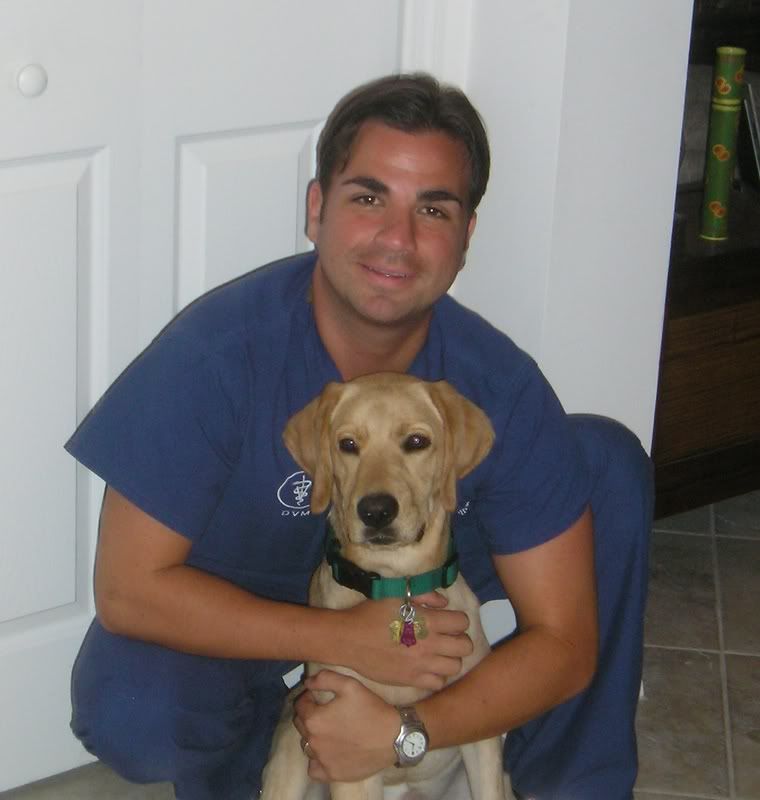
When our little furry critters eat less than wholesome, harmful, or obstructive items that subsequently make them sick, we call it dietary indiscretion. At no other time in the year are dietary indiscretion cases more common for both canines and felines, than the holiday season from Thanksgiving though New Years Day.
Case in point, to date since Thanksgiving, 2008, I have surgically removed turkey neck vertebra from a canine esophagus, a lobster claw from a canine small intestine, an ornament hook from a canine stomach, a sponge from a canine stomach, and a 6 inch section of yarn removed from a feline colon. In addition, while I cannot recall the exact number of vomiting and diarrhea cases I have treated in this time period due to owner feeding of rich holiday food, or pets being naughty and getting into holiday food or garbage, off the top of my head, I have treated at least 50 cases.
Therefore, in my final post of 2008, I implore all pet owners to be vigilant in keeping holiday food, ornaments, and garbage out of the reach of pets. I also strongly recommend resisting the temptation to allow pets to partake in the indulging of rich holiday food - while this may provide a moment of intense pet gratification, the negative consequences can last longer and be far more costly than the reward.
Wishing you and your families, including the furry ones, peace and happiness through this holiday season, and a happy New Year!
Tuesday, December 23, 2008

Sunday, December 14, 2008
Pet Health Insurance Rising In Bad Economy
With the average American's earning potential continuing to decrease in the current economic downturn, while veterinary costs steadily increasing nonetheless, pet health insurance has become more popular among pet owners, according to an article in Veterinary Practice News. Per the article, Pet Health Insurance premium sales this year have increased by 100,000 - 150,000 policies written from previous years nationwide. The article went on to cite a report that indicates that the pet health insurance industry is forcasted to grow by 25%-35% annually over the next 5 years.
From a veterinarian's perspective, this trend generally speaking is a poositive for the veterinary industry, but there are still some aspects that concern me. On one hand, quality pet health coverage helps pet owners pay for necessary veterinary care in the untimely incidence of pet illness or injury. Sick animals do not have to go without treatment because of financial constraints, and we get to perform our jobs to the best of our ability, unhampered by owner financial constraints. On the other hand, however, not all pet insurance companies are quality, and some pet owners are bound to get duped into purchasing premiums that ultimately do not fulfill expectations.
The solution for pet owners is to properly research pet health insurance companies before committing to a policy. Utilize consumer reporting agencies such as the better business bureau, and ask fellow pet owners and people in the pet care industry, such as groomers, trainers, and breeders, if they have pet health insurance preferences.
With more pet owners inquiring about pet insurance and veterinary clinics encouraging quality pet health insurance to help pet owners offset vet costs, many veterinarians are increasingly keeping a close eye on the industry, getting a solid feel for which pet health insurance companies are of good quality, and which ones should be avoided. This may make your vet a good source of pet health insurance company information and reputation.
Overall, I think that pet health insurance with a quality company under the current industry structure (re-reimbursement for vet costs remaining a matter directly between the owner and the insurance company with no veterinary clinic billing responsibilities), is a good idea for pet owners that do not think they could financially handle a sudden work-up and treatment regimen for their pet, that these days could approach a few to several thousands of dollars. A pet health insurance policy with a reputable company could be the difference in having to make the tough choice of choosing between the financial the stability of your family and saving the life of your beloved family pet.
Monday, December 1, 2008
We Love Lucy
About three months ago, a very nice lady brought in a 6 year old Labrador Retriever named Lucy to be put to sleep. The lady was agonizing over her decision to put Lucy down, because she had belonged to her best friend that had recently passed away in his sleep. The lady's friend told us that Lucy's owner had very little money, but whatever he had, he put into the care of his dog, cherishing his canine companion above everything else in life.
After he died, this friend of Lucy's deceased owner felt it was her obligation to take Lucy in both out of respect for the owner, as well as for the sake of a dog who had just lost her companion. However, once the lady's landlord caught wind of the fact that she had a dog in her home, he went ballistic, threatening to evict her on the spot due to his no dog policy. After she pleaded with him to make an exception to his rule given the special circumstances, the landlord did not budge, telling her that the eviction proceedings would begin immediately if she did not get rid of the dog.
Having no money to relocate, having no friends or family to take Lucy, and a cold hearted landlord that would not even grant her some time to seek other arrangements, the lady was left with two choices, either bring Lucy to the county shelter, or have her put to sleep. She chose the latter because of the fact that, although she was decently healthy, Lucy was middle aged, had very bad teeth, had chronic recurring allergic skin infections, and as such she felt that her chances of getting adopted were slim. She was unfortunately correct in her assumptions, and thought of her sitting in the strange setting of an animal shelter after having spent her life loved and doted on by her deceased owner, only to be put to sleep when nobody adopted Lucy was too heartbreaking for her to consider.
We were all devastated about the situation as well, and the fact that Lucy was a wonderfully sweet dog, made it all the more heart wrenching. With every one of us having reached our capacity in the number of animals we have adopted through the years, however, it did not look good for our ability to help Lucy and her new guardian. With very heavy hearts, we moved forward with getting the paperwork signed and the necessary injections drawn up.
At the last moment, one of my technicians, Melanie, overcome with tears, despite being already overburdened with rescue animals in her home, asked me if she would take the dog, would I spay her, repair her teeth, and treat her skin. To this I did not hesitate in telling her emphatically, "Absolutely!"
At this, we were overjoyed to enter the room and tell Lucy's guardian that there was a home for her, complete with a dedication to get her properly spayed and manage her ailments. The nice lady who had taken Lucy in on behalf of her deceased friend, was elated, relieved, and overjoyed. Although still grieving for the loss of her beloved friend, at least now she could engage in the grieving process without the guilt of knowing that her circumstances would not permit her to help the one thing her friend held dear in life.
Since then, Lucy has been spayed, her teeth repaired, and her skin comfortable and managed with appropriate medications. She is thriving in Melanie's home, getting on well with her assortment of rescues animals, and proving to be one of the best dogs Melanie ever had. Although Melanie's house is even more crowded than ever with rescue animals, she does not regret her decision to keep Lucy at all.
Just last week, a regular client of ours came in with his dog for a routine yearly, thanking us for helping the dog of "Sam, the one man band." As his name indicates, Sam was a one man musical act that performed some of the local pubs in the area, and was known by a select few pub goers, as a talented musician, as well as a kind and personable man who lived for his dog, Lucy. Only months after Sam's death when a few of his fans had wondered about his absence from the pubs, had they had learn of his circumstances. Their first concern being for Lucy, the one cherished treasure in Sam's life, all who knew him were relieved and moved to know that she had found a special home.
A heartwarming tale we can enjoy for the holidays.
Monday, November 24, 2008
Lindsay Lohan PETA's Latest Target
I wrote an article about the animal rights group, People for the Ethical Treatment of Animals (PETA), explaining how I have mixed emotions about the group. On one hand, their existence keeps those who engage in animal cruelty on notice, and often their work exposes legitimate animal abuse. On the other hand, however, sometimes some of their more extreme members can engage in controversial, odd, or in a few cases, even violent behavior, that hurts their credibility and imparts on them a aura of extremism.
The Daily Dish of SFGate.com reported on a recent incident where PETA has recently made news. According to The Daily Dish, as mink stole adorned Lindsay Lohan entered a Paris night club on Saturday night, November 15, 2008, an anti-fur activist pelted the actress with a large sac of flour and covered her with its contents. Aside from the humiliation of being dowsed in flour and having to rush to the bathroom to clean up, Lindsay was unharmed.
The Daily Dish article did not reveal if the anti-fur activist was affiliated with PETA, but PETA Europe's Robbie LeBlanc quickly applauded the attack, stating, "There is nothing remotely fashionable about the torture and death of animals killed for fur. Lindsay Lohan might be able to ignore images of bloody animals skinned alive for their pelts, but we hope a dash of flour will help her rise to the occasion and forsake fur once and for all." This seems to indicate that there could be a connection between PETA and the flour bomber.
When I first heard of this, I must admit that my first reaction was to have a pretty good chuckle, both because of the absurd nature of the incident, and because I am no fan of fur garments. However, I will concede that my dislike of fur could be fairly criticised as carrying and air of hypocrisy, since I do wear leather shoes and belts as well as favor leather seats in my cars. My only justification for this is that my skins come from animals that are already being slaughtered for food, and whether you buy into this justification, I do not approve of the killing of animals simply for their fur, although my use of leather certainly disqualifies me from being an anti-fur activist.
What should be clear to any rational person is, while a stance against the wearing of furs can be viewed as a humane and justified opinion, behavior like this is not the way to get the message out. Pelting Lindsay Lohan with a sac of flour will not likely cause her to rethink her wearing of furs, and to many people, these actions will cause people to view anti-fur people as kooky extremists rather than legitimate activists.
A better, more credible way to denounce Lindsay Lohan's choice of animal fur wardrobe, would have been to use blogs and other multimedia to bring attention to the fact that Ms. Lohan is setting a bad example in their opinion, of advocating the killing of animals for the purpose of harvesting their furs. In presenting this case in a more civilized fashion, perhaps Ms. Lohan would have suddenly seen the light and realized the implications of what she was wearing and pronounced that she would no longer wear animal furs. Perhaps she would have done this just for the sake of eliminating the potentially bad press.
Even if she had not responded at all, taking a higher road may have led many to be sympathetic to their cause, whereas following the flour bomb, there are probably more people that dismiss the actions of this PETA linked anti-fur activist as extreme, uncivilized, and mean spirited.
Roger Welton, DVM
Founder, WebDVM.net
Monday, November 17, 2008
Pets in the White House as American as apple pie.
Barack Obama, per his election victory speech promise to his daughters, will be carrying on the time honored tradition of pets in the White House. While this tradition has recently gained notoriety, probably due to our current historically peak levels of per capita household pet ownership, as well as ever expanding mass media, pets cohabiting with the first family in the White House is nothing new or even recent.
George Washington began the pet tradition as first President of the United States, as he kept with him one of his famed and beloved Revolutionary War steeds, Nelson, as well as an array of many other prized horses. Our first first lady had with her a cherished parrot.
Abraham Lincoln had an assortment of pets in the White House that included a pig, a turkey named Jack, and a dog named Jip. Not to be outdone, Theodore Roosevelt had a collection of pets that dwarfed that of honest Abe, including Algonquin, a calico pony, Pete, his favorite bull terrier, along with several other canines. President T. Roosevelt also had a Macaw named Eli Yale, as well as a lion, hyena, wildcat, coyote, five bears, two parrots, zebra, barn owl, snakes, lizards, rats, roosters, and raccoon.
Calvin Coolidge also had a literal zoo-like array of pets at the White House, which included as many as 12 dogs, several exotic bird species, two cats, a bear, a donkey, a wallaby, a bobcat, a bear, and a pigmy hippo.
Recently, our nation has become quite familiar with the Clinton's famous chocolate lab, Buddy, as well as President GW Bush's well known Scottish Terriers, Miss Beasley and Barney (who recently made headlines for biting a reporter).
A Presidential display of adoration of animals sets an example of compassion, illustrates the human animal bond at the highest level, and sets the bar high for responsible pet ownership. While we are still very much a work in progress in reaching optimal animal welfare standards as a nation, Presidential pets remind us that the majority of Americans are compassionate people, capable of selfless love and respect for animals.
I am please to know that Barack Obama and the first family elect will continue this endearing tradition.
For more indepth Presidential pet information, please refer to my primary source for the information contained in this post, the Presidential Pet Museum.
Roger Welton, DVM
Founder, Web-DVM.net
Sunday, November 9, 2008
The ultimate charlatan
In my January 24th article, "Careful pet owners, charlatans now target your pets!", I touched on this miracle canine medication creator whose credentials do not go beyond being a dog owner and self proclaimed independent researcher. As part of that article, I used him as a charlatan example with his peddling of a cure he developed for Cushings Disease that utilizes ingredients found at a local supermarket. In his sales pitch, he accused veterinarians of suppressing this knowledge because of our alignment with pharmaceutical companies that keep our loyalty with "great kickbacks, such as a free vacation for the family or a "convention meeting" (as they call it) that some how finds it's way in the good Dr's mail box."
Using the same advertising theme, "4 Facts Your Stupid Vet Failed To Tell You About [name your disease du jour]," Michael Dole now has a household supermarket item cure for the deadly canine viral disease, parvo. In his marketing of this product, Michael Dole suggests that veterinarians do not offer the best available treatments for parvo, indicating that the treatments we offer regularly fail because they consist merely of:
"Treatment A: No treatment at all (there's nothing we can do). In this case they will simply send your dog home to die.
or...
Treatment B: An IV and an overnight stay (maybe 3 nights). BUT don't be fooled by the complicated Dr talk. What you are basically paying for is an IV drip full of water and electrolytes meant to rehydrate your dog."
He goes on to say that veterinarians do not understand that the key cause of death from parvo is merely, "a simple matter of dehydration."
Please allow me to clarify the truth about parvo from a veterinarian's perspective. While dehydration is a significant factor in clinical disease and can lead to death by hypovolemic shock, the consequences of parvo are far more complex than just dehydration. Parvo attacks rapidly dividing cells of the GI tract or the bone marrow. In the GI tract, the result is sloughing of the lining of the GI tract, causing malabsorption and bleeding (hence the bloody diarrhea associated with the disease). In the bone marrow, the virus inhibits the patent's ability to make red blood cells and white blood cells. Red blood cells are the solid component of the blood stream responsible for oxygenating tissues, white blood cells are the first line of defense of against infection. Death can result from all this due to anemia, hypoxia (tissue oxygen depletion), and sepsis (systemic blood born infection).
According to Michael Dole, all we do to treat all this is offer an IV drip. Realistically, an IV drip to replace lost hydration and electrolytes, is but one component of a multifaceted treatment protocol. We also treat with antibiotics to fight secondary bacterial infection in the immune compromised patient. We treat with GI protectants to reduce GI hemorrhage and sloughing of the gut lining. In cases of severe anemia, we administer blood transfusions.
So Mr. Dole, since you have zero animal health care training, obvious both in your own listed credentials, as well as your twisted perceptions of veterinary care, please allow me to enlighten you. To call veterinarians stupid, insults the sacrifice, discipline, and hard work we poured into our education and training, as well as our ongoing dedication to the profession. To misrepresent how we implement treatment is appalling whether the result of ignorance or intentional deception. Not having purchased your product and not knowing what your supermarket parvo cocktail consists of, I will concede that there may be some benefit to parvo patients, perhaps even a decent alternative for pet owners who just unequivocally cannot afford veterinary care. But to try selling people on the notion that they should forgo veterinary medicine when parvo is suspected, in favor of your cocktail that you tout as a parvo treatment superior to the best treatment protocols veterinary medicine has to offer, is ridiculous, irresponsible, and puts pet's lives in danger.
I e-mailed this blog post to Mr. Dole. I challenge him to respond.
Thursday, October 30, 2008
A Veterinarian's Presidential Election Perspective
Political discussions often lead to heated debate, anger, and hurt feelings. However, with this upcoming election coming at a time when the country has so much at stake, it is difficult to resist political discussion in any setting, be it work, golf, in the gym, and of course here in this blog. While I ventured to broach some political issues in previous posts this year, one criticising government bipartisanly gouging small business, and one exposing Sarah Palin's abysmal wildlife record, I touched on where my support was leaning in this election, while falling short of a full out endorsement. In this post there will be no question where my allegiance lies in this election, but for the sake of this blog's integrity and audience, I will my views based on how political implications have and will continue to impact my life as a veterinarian.
In the early years of my career as an undergraduate biochemistry student working part time as a veterinary assistant right smack in the middle of the Clinton years, I witnessed a monumental change in veterinary medicine. With the prosperity and dramatic increase in mean income of the 1990s, people increasingly began to have the disposable income to focus on the family pet's health care. As a result, the profession improved with an increased ability to pursue aggressive and comprehensive diagnostic work-ups and treatments.
Veterinarians became more medically and surgically savvy, the additional revenue that this paradigm shift created increased veterinary hospital employee benefits, mean income, and as a result attracted higher quality staff. This combination of pet owner willingness, better diagnostics, treatments, and quality staff, meant better health care standards and quality of life for family pets, considered by many as cherished family members.
Personally, I had received a small inheritance as a young man, a helpful but modest sum of money. But because it was conservatively invested in the greatest bull stock market our country had ever known, that modest amount was stretched considerably to pay for undergraduate college (including a summer trip to Europe), a car that I drove for 8 years, a portion of vet school, and ultimately there was just enough left to purchase my wife's engagement ring.
Through my tenure as a veterinary student and during the early few years of my career, I continued to see the profession get better in all the ways I described before. Working in this environment and being subsequently able to practice a high level of medicine was extremely gratifying. This unfortunately was not to last, as around the middle of 2003 I began to witness a downturn in pet owners willingness to place pet health care among their higher financial priorities.
This was not a yet devastating reality at the time, not yet leading to losses, but instead a slowing or at worst, plateau effect in practice growth. The decreasing willingness to pursue high standard pet health care continued, however, by 2006 even deteriorating into outright cynicism from some pet owners presented with work-up and treatment estimates. Most scarily, we have seen our daily deposits which traditionally break down as 60% credit cards to 40% cash (or check), transform to 90%credit cards to 10% cash. It saddens me a great deal to see these good people still have the dedication to care for their animals but clearly no longer wield the disposable income to match their determination.
The good people in question, are the middle class, the biggest supporters and patrons of small business, and the group that has suffered the most under republican rule. Under Bush, we saw tax cuts that amounted to very little for the middle class, but provided billions in tax relief to the country's wealthiest corporations. Rather than use their gift from Bush to create jobs and uplift their eomployees letting that wealth trickle down as the republicans like to say, they instead stuffed the pockets of CEOs, shipped jobs overseas, and squandered employee pensions. The banking industry finally placed the icing on the cake, when massive republican sponsored deregulation helped pave the way for collosal Wall Street abuse that has led to our current credit crisis.
George Bush's abysmal economic policies and complete lack of regard for the middle class, a class of hard working, strong valued, decent Americans that are the life blood of small business, has created dire consequences that I see examples of every day. No longer is the middle class fallout a phenomena that we read about or fear the coming of - it has arrived, it is real, and it is in our faces every day.
Not only do I feel great sorrow for many of my clients that have been hit hard financially (many of whom are families that I have come to care deeply about), this economic disaster that George Bush has driven us into has compromised the very people I rely on for the existence of my business. He has created a chain effect that has the potential to compromise my business and its 8 other staff members. Without the middle class there is no Maybeck Animal Hospital.
In my years in the profession, I have witnessed the impact of how the financial health of the middle class supported by compassion and sound economic policy in the White House can uplift and bolster veterinary medicine; and how the exact opposite can occur under White House leadership that is rampant with greed, corruption, and gross incompetence. I have seen how a President who supports the free market and capitalism, but with proper regulation and oversight, can create a healthy investment environment; and how a President that lets big business have its way without oversight and regulation can create and environment where investing holds worse odds than Las Vegas. The current administration's blatant forsaking of the middle class while steadfastly pledging undying support for abusive big business is unconscionable.
And now the current republican presidential candidate who voted 95% of the time in lock step with George Bush (and bragged about this fact during the primaries) and has still yet to display one significant way in which he differs economically from George Bush, is trying to convince me that small business should fear a Barack Obama presidency? I am supposed to fear a man whose main tenant is support of the middle class, providing tax cuts for 95% of Americans and promising to not raise taxes on anyone making $250,000 per year or less?
Let's talk about health care. One aspect of my hospital policy that I hold dear is providing health care benefits for my employees and their families. John McCain's health plan is to provide a $5000 tax credit to put toward health insurance, but will in turn tax employer provided health benefits as income. Doing the math for all my employees, the tax credit makes some of them at best have the tax credit negated by the tax on their health benefits, while some of the employees actually end up paying more money to the government (in my case, for example, I would owe the government $1800 more).
Barack Obama by contrast, plans to provide my company with a 50% tax credit on the benefits I provide for my employees, freeing up money for equipment upgrades, staff and doctor continuing education, and better employee salaries and bonuses. Clearly, Barack Obama is not the candidate for a small business owner to fear. Indeed, John McCain with a health care policy that is even more tragically flawed than his economic vision, is the candidate in this election that small business owners should be running scared from.
That said, I am not so naive to think that Barack Obama is going to fly in on his unicorn and create an economic utopia with the wave of a wand. Thanks to his predecessor, he will be left with a dire economic reality, record deficits, and an oppressively expensive war to contend with, which may force his hand to dismiss or at least delay some of the programs on his wish list. But having a campaign that has been focused on the health of the base of small business, the middle class, I see a consistent and unwavering message that he will focus on looking after the great Americans that are the driving force of our nation and who I am proud to call my client base. By contrast, all I see from John McCain's campaign is a consistent and unwavering determination to vilely attack his opponent, trying to win our vote not on substance, sound policy, or concern for the middle class, but instead by trying to convince us that we should fear or distrust Barack Obama.
I have already casted my vote for Barack Obama. If you are a member of the middle class, a small business owner, or or simply care about the wellbeing of your country, you would be wise to do the same.
Roger Welton, DVM
Founder, Web-DVM
Subscribe to:
Posts (Atom)